Navigating the 2026 Tax Landscape: Your Year-End Tax Planning Guide

Year-end tax planning is a beneficial process for individuals, business owners and investors aiming to optimize their financial standing and minimize overall tax liabilities. As the tax landscape continues to evolve, proactive planning before the conclusion of the calendar year allows taxpayers to take advantage of specific provisions, manage income brackets and maximize deductions and credits.

For the 2026 tax year, navigating the complexities of the tax code requires a highly structured approach due to the passage of the One Big Beautiful Bill Act (OBBBA). This legislation fundamentally changes the year-end playbook, introducing critical new provisions such as a State and Local Taxes (SALT) cap phase-down, a 0.5 percent charitable contribution floor, a 35 percent cap on itemized deduction value, AMT phase-out changes, the Roth catch-up mandate and the end of initial Opportunity Zone deferrals. By evaluating income sources, deduction opportunities, investment strategies and compliance obligations ahead of the December 31 deadline, taxpayers can position themselves advantageously for the upcoming filing season.

One of the fundamental pillars of effective year-end tax planning involves careful management and timing of income and high-earner tax thresholds. Depending on individual circumstances, taxpayers may benefit from either accelerating or deferring income into the next tax year. For individuals anticipating a higher tax bracket in the current year compared to the next, deferring bonuses, capital gains or self-employment income can result in tax savings. Conversely, if future tax rates are expected to increase or if income is projected to be higher in subsequent years, accelerating income might be advantageous. Business owners face similar decisions regarding invoicing clients before year-end or delaying billing to shift revenue recognition into the following fiscal period. Strategic timing may help position income to be taxed at more favorable marginal rates, while remaining attentive to novel income categories, such as the new exemptions for tips, overtime pay, car loan interest and enhanced senior deductions, along with specific adjusted gross income (AGI) phase-out limits established for 2026. High-income earners must remain vigilant regarding the Alternative Minimum Tax (AMT) and the 3.8 percent Net Investment Income Tax (NIIT) on investment earnings, actively managing modified adjusted gross income (MAGI) to prevent unnecessary exposure.

Equally important to income management is the strategic acceleration or deferral of deductible expenses and healthcare accounts. Taxpayers who itemize deductions can often benefit from “bunching” deductible expenses, such as medical costs, charitable contributions and state and local taxes, into a single tax year to surpass the standard deduction threshold. For 2026, the federal standard deductions are adjusted to $16,100 for single filers, $32,200 for married couples filing jointly and $24,150 for heads of household, alongside a temporary senior bonus deduction for adults aged sixty-five and older. Scheduling elective medical procedures, purchasing necessary business equipment or paying upcoming property taxes before the end of the year can successfully push taxpayers past these higher thresholds. Taxpayers should audit their medical Flexible Spending Accounts (FSAs) ahead of December 31 to avoid forfeiting funds under the use-it-or-lose-it rule, while maximizing contributions to Health Savings Accounts (HSAs) to leverage triple tax advantages and above-the-line deductions that reduce AGI.

Retirement account optimization and strict compliance with distribution rules remain important for robust year-end tax strategies. Contributing the maximum allowable amounts to employer-sponsored retirement plans can lower taxable income for the year. Retirees and inherited IRA beneficiaries should calculate and execute Required Minimum Distributions (RMDs) prior to December 31 to avoid excise taxes and penalties. Individuals should also evaluate whether a Roth conversion makes sense for their financial situation, converting traditional pre-tax retirement funds into a Roth account during a year with lower-than-average income to lock in a potentially lower tax rate, allowing future growth and qualified withdrawals to be tax-free. However, taxpayers should generally avoid executing Roth conversions during years with large liquidity events. A conversion in a year of abnormally high income exposes more dollars to AMT and NIIT pitfalls, which can negate the desired rate arbitrage. Because Roth conversions are treated as taxable income in the year they occur, careful calculation of tax brackets is necessary to avoid inadvertently pushing income into a higher marginal bracket or triggering additional surtaxes.

Investment portfolios may also be reviewed as the calendar year draws to a close. Tax-loss harvesting is a technique where investors sell underperforming assets at a loss to offset capital gains realized elsewhere in the portfolio. If capital losses exceed capital gains, up to a specified limit of ordinary income can be offset, providing an additional layer of tax relief. Investors should coordinate harvesting strategies closely with the 20 percent long-term capital gains and NIIT thresholds to maximize efficiency. Investors must also remain mindful of the wash-sale rule, which prohibits purchasing a substantially identical asset within thirty days before or after the sale to claim the loss.

Beyond loss harvesting, 2026 brings critical, time-sensitive deadlines for Opportunity Zones under OBBBA. Gains deferred under the original Qualified Opportunity Fund (QOF) program must be recognized on December 31, 2026, with tax due on the 2026 return, requiring affected clients to plan for liquidity and estimated payments now. Because OBBBA’s permanent Opportunity Zone program applies to investments made after December 31, 2026, gains realized late in 2026 may be eligible for reinvestment in a new-program QOF in 2027 within the standard 180-day window (subject to confirmation with tax counsel). Evaluating dividend distributions and capital gains distributions from mutual funds prior to year-end also helps prevent unexpected tax surprises during tax season.

Charitable giving and wealth transfer strategies offer avenues for philanthropy and tax reduction, though OBBBA introduces significant new parameters for 2026. The headline for year-end giving is the restructuring of charitable deductions. Itemized charitable deductions are now subject to a 0.5 percent of AGI floor, and for taxpayers in the 37 percent bracket, itemized deductions are reduced by 2/37, effectively capping the benefit at 35 percent. Non-itemizers can utilize a new $1,000 (single) or $2,000 (joint) cash deduction, though this cannot be used for gifts to Donor-Advised Funds (DAFs) or private foundations. Because the floor and cap continue in 2027, preventing rate arbitrage between years, the new 0.5 percent floor makes “bunching” several years of giving into a DAF in a single year highly attractive, as the floor is only absorbed once. Donating appreciated securities directly to qualified charitable organizations still allows donors to deduct the full current market value of the assets while entirely bypassing capital gains taxes that would have been incurred upon a direct sale.

For retirees subject to RMDs, utilizing Qualified Charitable Distributions (QCDs) offers a tax-efficient mechanism to fulfill distribution requirements directly from an IRA without increasing adjusted gross income. The 2026 QCD limit is $111,000 per IRA owner age 70½ or older, with a one-time split-interest QCD limit of $55,000. While the dollar amounts are capped, QCDs are exceptionally valuable under the new rules because they are excluded from income entirely, completely avoiding both the 0.5 percent floor and the 35 percent deduction cap. Note, however, that QCDs cannot be directed to a DAF or private foundation.

For estate and wealth planning, the 2026 annual gift tax exclusion remains set at $19,000 per recipient, meaning a married couple splitting gifts can transfer up to $38,000 per individual without incurring gift taxes or eating into lifetime limits. The federal lifetime estate and gift tax exemption stands at $15 million per individual, or $30 million for a married couple via portability or proper planning. Utilizing these exclusions before December 31 allows families to transfer assets and shield future asset appreciation from taxation.

Small business owners and self-employed individuals should pay special attention to year-end equipment purchases, state tax workarounds and depreciation rules. Expensing provisions under tax regulations allow businesses to deduct the full cost of qualifying equipment and software purchased and placed in service before the end of the year, providing a strong incentive to upgrade technology, machinery or infrastructure while lowering business taxable income. Crucially, the Pass-Through Entity (PTET) election survived OBBBA and is arguably more vital than ever, as high-income owners with a MAGI above approximately $606,000 are subject once again to a strict $10,000 SALT cap. Business owners must coordinate these PTE taxes where applicable to mitigate the federal cap on state and local tax deductions. Readers should be reminded that many states require the election and actual payment to be made by December 31 to secure a 2026 federal deduction, making this a critical year-end action item. Structuring owner compensation, evaluating qualified business income deductions and reviewing entity classifications with a qualified tax professional ensure that business structures remain optimized for tax efficiency.

Looking Ahead: 2027 Planning Considerations
While finalizing 2026 actions is the immediate priority, taxpayers should also maintain visibility into 2027. The sweeping provisions established by OBBBA, including the new charitable floors and deduction caps, will largely carry forward, meaning there is little cross-year rate arbitrage opportunity on deductions. However, key thresholds will undergo inflation adjustments, and strategic planning will require transitioning to the permanent Opportunity Zone rules taking effect in 2027, adapting to Roth catch-up mandates, and continually assessing state-level PTET workarounds.

Finally, proper management of estimated tax payments, comprehensive recordkeeping and professional consultation are important components of a successful tax strategy. Taxpayers should review their year-to-date withholdings and quarterly estimated payments against the safe harbor rules, paying at least 90 percent of the current year’s tax liability or 110 percent of the prior year’s liability, to avoid unexpected underpayment penalties in April. Tax laws are intricate and subject to legislative changes, making it important to stay informed about current 2026 thresholds, phase-outs and credit availability. Maintaining organized records of receipts, donation acknowledgments, investment transactions and business expenses simplifies the preparation process and ensures that all legitimate claims are substantiated.

Your Oxford team brings deep experience working with families and business owners on their overall planning goals and objectives. In coordination with your legal and tax advisors, we apply thoughtful, customized strategies to help ensure peace of mind and financial optimization as the year concludes.

Oxford Financial Group, Ltd. (“Oxford”) is a Registered Investment Advisor (“RIA”) with the U.S. Securities and Exchange Commission (“SEC”) and is headquartered in Carmel, Indiana. Registration with the SEC does not imply a certain level of skill or training. Additional information about Oxford, including our Form ADV and Privacy Policy, is available upon request by calling 800.722.2289 or emailing info@ofgltd.com. The content of this presentation is intended for educational and illustrative purposes only. It should not be construed as investment, tax, or legal advice, nor as a recommendation or offer to buy or sell any security or investment product. The strategies referenced above are illustrative in nature and may not be available, suitable or advisable for every individual, entity or transaction. No strategy discussed guarantees the achievement of any tax, estate planning or transaction objective. Investing involves risk, including possible loss of principal. Tax and legal counsel should be engaged before taking any action. This material has been prepared using original sources believed to be reliable, but no representation is made as to its accuracy or completeness. The views expressed are those of Oxford as of the date of the presentation and are subject to change based on market, regulatory or economic conditions, which may not occur as anticipated. For full disclosures and disclaimers, please visit https://ofgltd.com/home/disclaimers. OFG-2610-33
The Opportunity Zone Bridge: Navigating the 2026 Tax Transition, Capital Lock-Up and the Architecture of OZ 2.0

For nearly a decade, the Qualified Opportunity Zone (QOZ) program lived under a statutory deadline. Enacted under the Tax Cuts and Jobs Act of 2017, it required investors to recognize all deferred capital gains no later than December 31, 2026. That deadline is why late 2026 has become such an active planning season for family offices holding legacy Qualified Opportunity Fund (QOF) positions.

At its simplest, a Qualified Opportunity Zone (QOZ) is a designated low-income census tract that Congress wants to see more private investment reach. A Qualified Opportunity Fund (QOF) is the vehicle that gets capital there. It pools eligible capital gains from investors, and in exchange for deploying that money into qualifying property or businesses inside a QOZ, it offers deferral and eventual reduction of the tax on those gains.

The One, Big, Beautiful Bill Act of 2025 (OBBBA) changed the underlying premise. Section 70421 made the Opportunity Zone program permanent, and IRS Notice 2026-40, transitional guidance from the Treasury Department and the IRS, supplies the rules connecting the expiring legacy regime (“OZ 1.0”) to the new permanent framework (“OZ 2.0”). Together they turn what was once a temporary incentive into a recurring feature of the tax code, complete with its own mechanics, its own deadlines and, since this is still a ten-year illiquid commitment, its own opportunity cost.

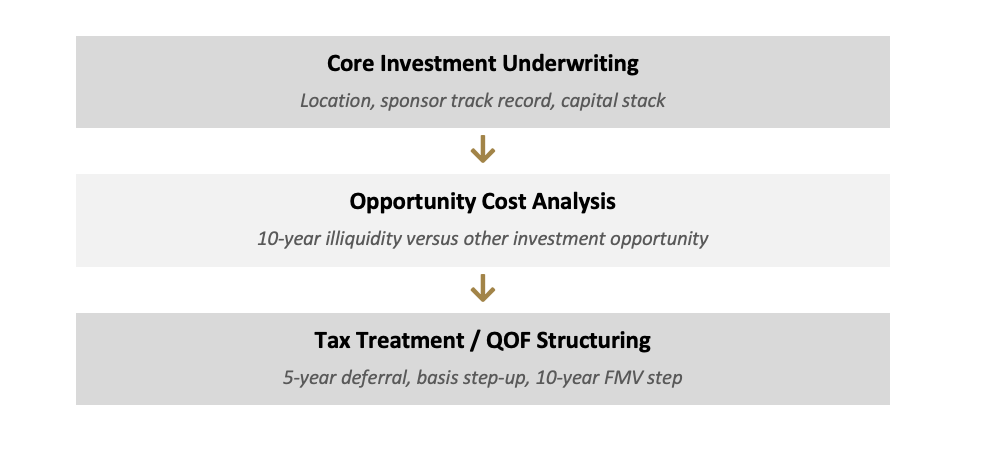
We will walk through what changed in the transition and what stayed the same, then turn to the question most relevant to Qualified Opportunity Zones: Does the tax benefit outweigh the investment risk, illiquidity, fees and opportunity cost that come with it?

Notice 2026-40 and the Permanent OZ 2.0 Regime

Congress originally designed Opportunity Zones under IRC §1400Z-2 as a temporary economic development tool, offering deferral of capital gains through 2026, a partial basis step-up for early investors and elimination of tax on post-acquisition appreciation after a 10-year hold. Section 70421 of the OBBBA converted that temporary structure into a permanent one. Under OZ 2.0, state governors will nominate low-income census tracts for recurring 10-year designation cycles, with the first cycle running from January 1, 2027 through December 31, 2036.1

Notice 2026-40, a piece of transitional guidance issued by Treasury and the IRS rather than a statute in its own right, resolves several open questions in bridging the two regimes. Chief among them is the statutory cap limiting designated zones to 25% of a state’s low-income communities “during any period” under §1400Z-1(d)(1). Because legacy OZ 1.0 tracts remain designated through December 31, 2028, some advisors worried the overlap would shrink the number of new tracts available for OZ 2.0. The Notice clarifies that the 25% cap applies independently to each 10-year designation period, so existing OZ 1.0 tracts do not reduce the inventory available for new OZ 2.0 nominations.2

Rev. Proc. 2026-14 sets the nomination calendar. State chief executives were able to submit and revise OZ 2.0 nominations from July 1, 2026 through September 28, 2026, with a single 30-day extension available on request. Treasury and the IRS identified 25,332 eligible census tracts nationwide, of which 8,334 are composed entirely of a rural area and qualify as Rural Opportunity Zones.3

The distinction matters for planning. Capital invested through a Qualified Rural Opportunity Fund (QROF) in one of these tracts could receive as much as a 30% basis step-up at the five-year mark, three times the 10% standard step-up available elsewhere under OZ 2.0, reflecting Congress’s intent to direct more of the permanent incentive toward non-metropolitan communities.4

An OZ 1.0 tract does not automatically carry forward into the new regime, a detail that catches many clients by surprise. Each tract must independently satisfy OZ 2.0’s tightened eligibility test and receive its own nomination and designation, and new capital deployed into a tract that is not renominated will not qualify for OZ 2.0 treatment.5

A key point to note is that many states and localities apply their own conformity rules, and some run separate opportunity zone-style programs of their own, so confirming state treatment before relying on any after-tax projection is a reasonable starting point.

OZ 2.0 Versus OZ 1.0: What Actually Changes

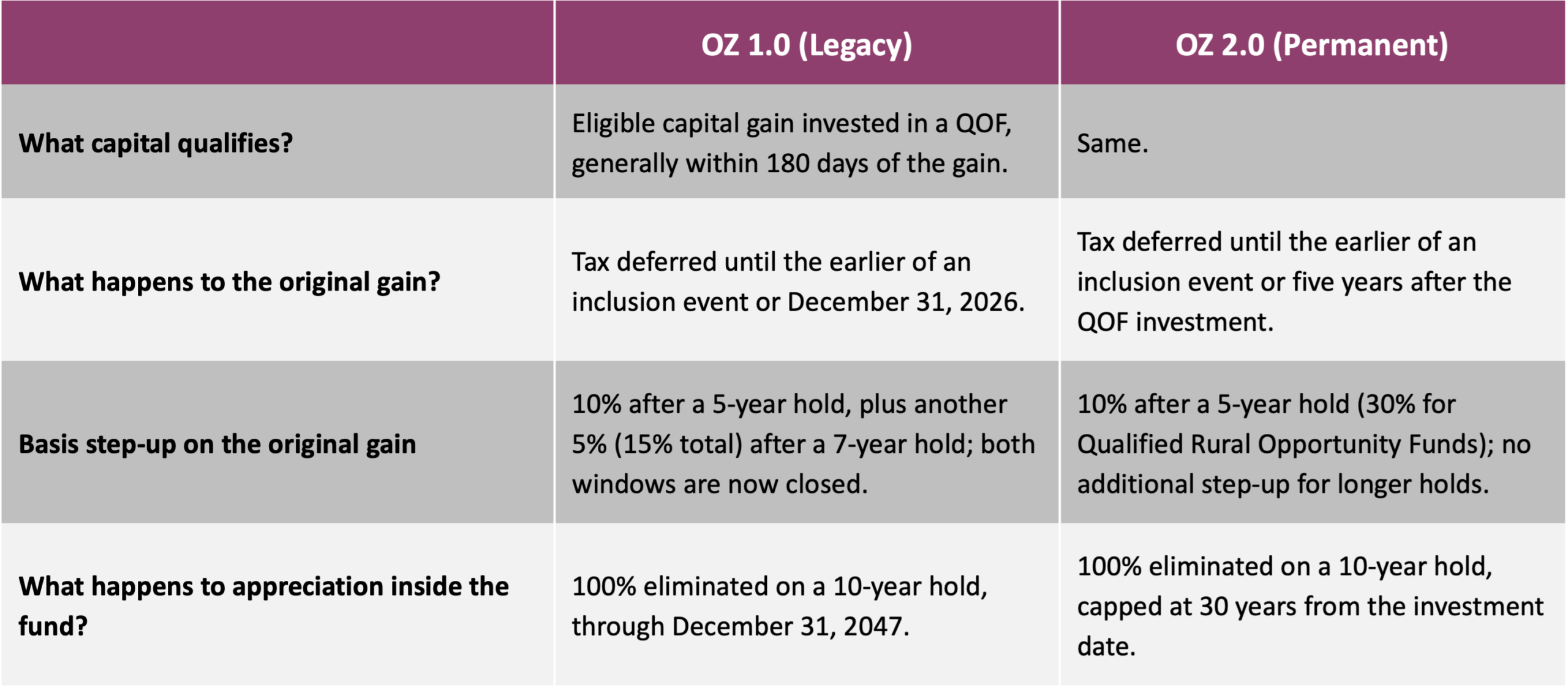
The permanent regime changes more than the sunset date. The mechanics are easiest to follow once you separate the two tax incentives at work here, deferral on the original capital gain and elimination of tax on the fund’s own appreciation, since conflating them is the most common source of confusion.6

The Deemed Inclusion Event

Two mechanics deserve a closer look because they affect every legacy investor regardless of new deployment plans. Under Section 4.01 of Notice 2026-40, every legacy QOF investment still held as of December 31, 2026 must recognize its remaining deferred gain on the 2026 return, payable in spring 2027. That gain cannot be re-deferred into a new fund; the original deferral election remains in effect, so the recognized amount is not treated as new eligible gain. The taxable amount is the original deferred gain, reduced by any basis step-up already earned under the 5- or 7-year holding rules above. It is further capped at the investment’s fair market value on December 31, 2026 if that value is lower, which is why a rigorous, independent valuation matters in any sector where values have softened. Paying this tax does not end the benefit. An investor who keeps the QOF interest for a full 10 years may still qualify for the step-up to fair market value on disposition under §1400Z-2(c), through December 31, 2047 for legacy assets.7

The Safe Harbor for Legacy Developers

Tangible property acquired after December 31, 2026 in an OZ 1.0 tract will generally fail to qualify as Qualified Opportunity Zone Business Property unless it fits one of two exceptions under Section 5.01: a written working capital plan (up to 31 months) adopted by December 31, 2026, with at least 10% of capital received and 5% expended or committed by that date, or an ordinary-course replacement of existing assets, such as routine renovations, that does not expand the project’s footprint or scope.8

For new capital, the practical difference comes down to timing. Gain deployed into a QOF on or before December 31, 2026 falls under OZ 1.0 and offers no step-up, and deferral only through December 31, 2026; the same gain, deployed on or after January 1, 2027, starts a fresh five-year deferral clock and a 10% (or 30% for Qualified Rural Opportunity Funds) basis step-up under OZ 2.0.

Evaluating the Opportunity Cost of Capital Lock-up

Tax incentives are only half of the underwriting question. Sound family office governance calls for weighing that benefit against what the capital would otherwise earn, and against how long it will be committed.

The 10-Year Illiquidity Premium

Whether under OZ 1.0 or OZ 2.0, the core benefit, elimination of tax on appreciation under §1400Z-2(c), requires a minimum 10-year hold, and up to 30 years under the new statutory cap. In a zero-rate environment, locking up capital for a decade was a low-cost trade. In a higher-for-longer environment where core fixed income, private markets and public equities may offer competitive after-tax returns on their own, that same lock-up now carries a genuine cost, in the form of reduced ability to rebalance through a market dislocation and, for ground-up projects, added exposure to development, supply chain and refinancing risk over a long horizon.

The Phantom Tax Cash Drag

Legacy investors face a distinct liquidity event in spring 2027. The tax bill on the 2026 deemed inclusion gain comes due in outside cash, while the underlying asset may still be years from stabilization. Sponsors that once expected to fund these liabilities through cash-out refinancings now face a tighter debt market, which shifts more of that burden onto the family office’s own balance sheet.

Sponsor and Fee Scrutiny

A QOF deserves the same underwriting rigor as any private equity commitment. Acquisition fees, professional fees and other costs can erode the after-tax benefit the code is designed to provide. The underlying investment can still lose money like any illiquid real asset, and tax benefits can be forfeited through noncompliance, independent of investment performance, if a QOF or QOZB fails to meet asset-testing or certification requirements.

What the Data Actually Shows

An August 2026 Government Accountability Office (GAO) review put total Opportunity Fund assets at roughly $108 billion at the end of 2024, concentrated in urban multifamily housing, mixed-use development and hotels. GAO found, echoing a similar finding in its 2020 review, that no centralized data exists on which projects are funded, and that investment has skewed toward tracts that already had infrastructure and community support in place, rather than the most economically distressed communities the program was designed to reach. The earliest QOF investments were made in 2018 and 2019, however, so the first cohort of full 10-year holds is only now maturing. Even a complete data set today would say relatively little about realized, full-cycle outcomes, since most of the program’s history to date has been the accumulation phase rather than the exit phase.9

OZ 2.0 takes a meaningful step toward closing this gap. The permanent regime requires QOFs to report fund and investor characteristics annually, with Treasury due to publish outcome data by the program’s sixth year. As that reporting accumulates, investors and their advisors should be better positioned to judge whether realized returns justify the illiquidity, fees and opportunity cost described throughout this piece, rather than relying on the tax mechanics alone. None of this diminishes the tax benefits available today, but it does argue for underwriting the underlying investment on its own merits.10

Estate and Trust Considerations

An Opportunity Zone position raises estate and trust questions best surfaced well before a liquidity event forces the issue. What happens to a QOF interest at death, including how it is valued and whether the fund’s own operating agreement restricts transfer, deserves the same attention as any other illiquid asset in an estate plan. Lifetime gifting of a QOF interest raises its own question about whether the transfer itself triggers an inclusion event. And for a trust considering a QOF allocation, the illiquidity described above deserves a hard look against the trust’s distribution obligations to beneficiaries. These are highly fact-specific questions, best worked through with counsel alongside the family’s broader estate plan.

Conclusion

Notice 2026-40 accomplishes what it set out to do: it gives legacy investors, developers and fund sponsors a workable bridge from a temporary incentive to a permanent one, with transitional guidance for the 2026 transition and a durable framework beyond it. That clarity is valuable, but it answers a different question than whether a given Opportunity Zone investment is the right long-term financial play for a portfolio.

The permanence of OZ 2.0 means this decision will keep coming up, for existing legacy positions working through the 2026 transition and for new capital weighing deployment into the years ahead. Families and their advisors are likely best served by treating the tax benefit as one input among several, alongside the underlying investment’s own merits, its illiquidity, its estate and trust implications and the still-thin record of how prior-generation Opportunity Zone investments have actually performed. How much weight each family gives those factors is, appropriately, a complex equation that needs to be an ongoing consideration.

One related structure we get asked about often is the two-layer strategy of operating a Qualified Opportunity Zone Business directly within a QOF. It carries its own operating, financing and exit considerations beyond the scope of this piece, and we plan to address it, along with the risks specific to it, in a follow-up article.

Clients with questions about how this topic may relate to their own circumstances are encouraged to speak with their Oxford advisory team and their tax and legal advisors.

Oxford Financial Group, Ltd. (“Oxford”) is a Registered Investment Advisor (“RIA”) with the U.S. Securities and Exchange Commission (“SEC”) and is headquartered in Carmel, Indiana. Registration with the SEC does not imply a certain level of skill or training. Additional information about Oxford, including our Form ADV and Privacy Policy, is available upon request by calling 800.722.2289 or emailing info@ofgltd.com. The content of this presentation is intended for educational and illustrative purposes only. It should not be construed as investment, tax or legal advice, nor as a recommendation or offer to buy or sell any security or investment product. The strategies referenced above are illustrative in nature and may not be available, suitable or advisable for every individual, entity or transaction. No strategy discussed guarantees the achievement of any tax, estate planning or transaction objective. Investing involves risk, including possible loss of principal. Investing involves risk, including possible loss of principal. Tax and legal counsel should be engaged before taking any action. This material has been prepared using original sources believed to be reliable, but no representation is made as to its accuracy or completeness. The views expressed are those of Oxford as of the date of the presentation and are subject to change based on market, regulatory or economic conditions, which may not occur as anticipated. For full disclosures and disclaimers, please visit https://ofgltd.com/home/disclaimers. OFG-2610-05

1 One, Big, Beautiful Bill Act, Pub. L. No. 119-21, § 70421 (2025), amending IRC § 1400Z-1(f)(1).
2 IRC § 1400Z-1(d)(1); IRS Notice 2026-40, § 3.01(1) (June 18, 2026).
3 Rev. Proc. 2026-14 (IRS, Apr. 6, 2026).
4 IRC § 1400Z-2(b)(2)(B)–(C), as amended by One, Big, Beautiful Bill Act, Pub. L. No. 119-21, § 70421 (2025).
5 Rev. Proc. 2026-14 (IRS, Apr. 6, 2026).
6 IRC §§ 1400Z-2(a)–(c), as amended by One, Big, Beautiful Bill Act, Pub. L. No. 119-21, § 70421 (2025); IRS Notice 2026-40, §§ 4.01, 5.01–5.02 (June 18, 2026).
7 IRS Notice 2026-40, § 4.01 (June 18, 2026); IRC § 1400Z-2(a), (c).
8 IRS Notice 2026-40, § 5.01(2)–(3) (June 18, 2026).
9 U.S. Government Accountability Office, GAO-26-108132, Opportunity Zones: Effects of Original Tax Incentive Mostly Unknown and Revised Incentive May Offer Improvements (Aug. 24, 2026).
10 REG-116506-25, 91 Fed. Reg. 57968 (proposed Sept. 11, 2026).

Maximizing Transaction Value Through Pre-Letter of Intent Tax Structuring

Navigating the sale of an operating company is a defining moment for founders and major shareholders. Years of operational focus finally culminate in a liquidity event. Yet, a surprising number of sellers make a critical strategic error by delaying their tax and estate planning until after a Letter of Intent (LOI) is signed. Once the ink dries on an agreement, the window for implementing the most effective wealth preservation strategies slams shut. The transaction’s economic reality is effectively set, and regulatory authorities often view subsequent planning moves through the restrictive lens of the assignment of income doctrine. To pursue more effective tax positioning, especially in transactions involving rolled equity held through a partnership structure, stakeholders must evaluate and execute pre-transaction strategies long before the formal deal parameters are finalized.

The foundational element of any equity rollover is ensuring the structure achieves the intended tax deferral. In a partnership context, this requires strict adherence to Section 721 of the Internal Revenue Code, or Section 351 depending on the entity framework. The objective is to keep the rolled portion of the equity fully tax-deferred. A common trap during this phase is the inadvertent triggering of a taxable event through what is categorized as a disguised sale under Section 707. Advisors must meticulously review the proposed flow of funds. Furthermore, auditing Section 752 debt allocations is mandatory. When a transaction results in a partner being relieved of their share of partnership liabilities, that debt relief is treated as a distribution of cash. If this hypothetical distribution exceeds the partner’s outside basis, it generates unexpected phantom income at closing. Sellers expecting a tax-free rollover can find themselves facing a substantial tax bill without the corresponding liquidity to pay it simply because pre-deal debt allocations were ignored.

Beyond the rollover mechanics, proactive stakeholders can look toward maximizing statutory tax exemptions, most notably the Qualified Small Business Stock (QSBS) exemption under Section 1202. If the operating company qualifies, early planning may be highly beneficial, though the rules have recently become bifurcated based on when the stock was issued. For QSBS issued prior to July 5, 2025, a taxpayer who meets the strict five-year holding period can generally exclude eligible gain up to the greater of $10 million or 10x their adjusted basis in the stock. However, for QSBS issued on or after July 5, 2025, the One Big Beautiful Bill Act significantly expanded these benefits. The fixed per-issuer exclusion cap was increased to $15 million, which will be indexed for inflation, while retaining the alternative 10x-basis rule. Additionally, the new law introduces a tiered holding period, allowing a 50% gain exclusion after three years, 75% after four years and a full exclusion at five years. For founders with a near-zero basis, the fixed dollar cap (whether $10 million or $15 million) is the default, but through a strategy known as stacking, this limitation can be legally multiplied. By gifting shares into multiple distinct non-grantor trusts before a deal materializes, a founder can potentially secure a separate exclusion for each trust. Timing is the crucial variable here. If these transfers occur after a LOI is signed, the transaction will likely be challenged on the basis that the right to the proceeds had already ripened and the tax liability belongs to the original owner.

Managing federal exposure is only half the equation, as state tax mitigation requires equal foresight. Depending on the seller’s state of residence and the specific tax exposure on the anticipated cash proceeds, establishing an incomplete non-grantor (ING) trust in a favorable jurisdiction like Delaware or Nevada can provide substantial relief. These structures allow sellers in high-tax states to legally shift the situs of the intangible asset before the sale, minimizing state income tax on the eventual capital gain. However, sellers in states with recent anti-ING legislation, such as California and New York, will find this is no longer an option. Alternatively, sellers must evaluate whether their existing partnership structure can make a valid Pass-Through Entity tax election regarding the transaction gain. A properly executed election can provide a workaround to the federal cap on state and local tax deductions, yielding a federal tax benefit. This requires careful financial modeling to understand the interaction between federal deduction benefits, statutory election deadlines and any complex state sourcing issues.

For sellers with philanthropic objectives, the pre-transaction period offers unique opportunities to align charitable giving with significant tax advantages. Transferring a portion of pre-transaction shares into a Charitable Remainder Trust (CRT) allows a seller to claim a partial upfront charitable deduction while retaining an annual cash flow stream. In this structure, the initial capital gain is not permanently eliminated, but it is effectively deferred and taxed over time as the seller receives the income stream. Alternatively, gifting a portion of the business interest directly to a Donor Advised Fund (DAF) provides a more immediate tax benefit. This approach yields a charitable deduction based on the fair market value of the shares and eliminates personal capital gains taxes on the future sale of that specific equity. When dealing with partnership interests, however, a critical prerequisite is verifying that the interest slated for donation does not carry a negative tax capital account. Gifting an interest with liabilities exceeding basis can inadvertently trigger a taxable event, defeating the purpose of the charitable transfer.

At the portfolio level, sellers must anticipate the character of the incoming gain and look for existing offsets. If the gain from the transaction is characterized as passive income, a comprehensive audit of the seller’s broader investment portfolio is necessary to identify any suspended passive losses. Harvesting these dormant losses to offset the influx of transaction gain is an efficient way to reduce the immediate tax burden. Understanding how basis will be treated in the deal is essential. Because partnerships maintain a single unified basis for each partner, sellers cannot cherry-pick specific high-basis tax lots to roll over while selling low-basis lots for cash. Understanding exactly how the unified basis will be allocated between the cashed-out portion and the rolled equity dictates the immediate tax reality and helps ensure the maximum possible gain is deferred. Additionally, because middle-market transactions often involve a portion of the purchase price being held in escrow for indemnification and post closing adjustments, sellers should ensure the escrow is subject to a ‘substantial restriction’ (for example, indemnity based holdbacks) to qualify for installment sale treatment. Without such restrictions, doctrines like constructive receipt or the step transaction rule can cause the escrowed funds to be taxed immediately.

While the focus is heavily weighted toward pre-deal structuring, having a definitive strategy for the post-close cash proceeds is equally vital. The tax code offers strict, time-sensitive windows for rolling cash proceeds into tax-advantaged vehicles. Sellers might consider deploying a portion of their liquidity into a Qualified Opportunity Fund, which must typically be completed within a short window following the sale. This allows for the deferral of the recognized capital gain and offers tax-free growth on the new investment if held for a decade. If the sold company was eligible for QSBS treatment but the seller had not yet met the requisite five-year holding period, they have a remarkably brief sixty-day window to execute a Section 1045 rollover. By reinvesting the proceeds into another qualifying business within two months, the seller can defer the gain and tack their holding period onto the new investment, preserving the ultimate exemption.

A comprehensive approach to transaction planning may also incorporate an overlay of estate planning. A liquidity event provides a natural valuation inflection point, making the pre-deal period an ideal time to transfer wealth to the next generation. If the timeline permits before the transaction parameters are finalized, stakeholders can evaluate utilizing vehicles like Grantor Retained Annuity Trusts (GRAT) or Intentionally Defective Grantor Trusts (IDGT). By transferring a portion of the equity at its current pre-transaction valuation, the seller locks in a lower value for gift tax purposes. When the transaction closes and the rolled equity appreciates in the new capital structure, all that future growth occurs entirely outside of the seller’s taxable estate. This shields generational wealth from estate taxes while keeping the economic upside intact.

Executing a successful business transition requires balancing operational demands with complex financial engineering. Not every tax strategy will perfectly align with the specific dynamics of every deal, but the greatest risk is the forfeiture of these opportunities due to a compressed timeline. Tax mitigation and wealth preservation are not post-deal cleanup tasks; they are primary drivers of net transaction value. By engaging advisors and coordinating these actionable strategies before a formal agreement is ever drafted, stakeholders can protect their wealth, help mitigate unnecessary tax friction and step into their transaction with more clarity.

Your Oxford team brings deep experience working with business owners, founders and long-standing trust structures. In coordination with your legal and tax advisors, we apply thoughtful, customized strategies designed to help ensure your wealth transfer plan remains aligned, effective and enduring across generations.

Oxford Financial Group, Ltd. (“Oxford”) is a Registered Investment Advisor (“RIA”) with the U.S. Securities and Exchange Commission (“SEC”) and is headquartered in Carmel, Indiana. Registration with the SEC does not imply a certain level of skill or training. Additional information about Oxford, including our Form ADV and Privacy Policy, is available upon request by calling 800.722.2289 or emailing info@ofgltd.com. The content of this presentation is intended for educational and illustrative purposes only. It should not be construed as investment, tax, or legal advice, nor as a recommendation or offer to buy or sell any security or investment product. The strategies referenced above are illustrative in nature and may not be available, suitable or advisable for every individual, entity or transaction. No strategy discussed guarantees the achievement of any tax, estate planning or transaction objective. Tax and legal counsel should be engaged before taking any action. This material has been prepared using original sources believed to be reliable, but no representation is made as to its accuracy or completeness. The views expressed are those of Oxford as of the date of the presentation and are subject to change based on market, regulatory or economic conditions, which may not occur as anticipated. For full disclosures and disclaimers, please visit https://ofgltd.com/home/disclaimers. OFG-2608-22

Before the Exit: The Strategic Advantage of Pre-Sale DAF Contributions

Contributing privately held company interests to a Donor Advised Fund (DAF) before a liquidity event can be a powerful planning strategy available to founders and early investors. The mechanics are straightforward in concept but require careful consideration. By transferring an ownership interest into a 501(c)(3) donor vehicle prior to the sale, the donor captures a charitable deduction at fair market value (FMV) and removes the transferred asset from the taxable estate, while the DAF, as a tax-exempt owner, realizes the sale proceeds free of capital gains tax. The combined effect is greater charitable capital and improved after-tax outcomes for the donor. The catch is timing. If the transfer occurs after a definitive sale agreement is executed or when the deal is in substance already closed, tax authorities are likely to treat the gift as an assignment of income and deny the intended benefits. Early coordination among tax counsel, valuation experts, wealth managers and the DAF sponsor is crucial.

There are several financial attractions of a pre-sale DAF contribution. First, because the DAF pays no capital gains tax on sale proceeds, 100 percent of the gross cash attributable to the gifted interest flows into charitable assets rather than being eroded by tax. For a founder donating a meaningful slice of a highly appreciated stake, the difference between donating post-sale net proceeds and donating the stock pre-sale can be substantial in philanthropic capital. Second, donors who have held the stock for more than one year can generally claim an immediate income tax deduction equal to the FMV of the gifted interest, subject to charitable contribution limits based on Adjusted Gross Income (AGI). The ability to capture a full fair market value deduction in a high-income year is often the defining success of an integrated tax and philanthropic strategy. Third, a DAF separates the tax event from the grant decision. Donors receive the tax benefit immediately while retaining the ability to recommend grants from the DAF over time, allowing for intentional, mission-driven deployment of large charitable resources without the administrative burden of operating a private vehicle.

Despite these clear advantages, there are several technical and practical pitfalls that can defeat the strategy if not addressed in advance. The most important is the anticipatory assignment of income and related step-transaction doctrines. If a donor transfers shares to a DAF after a Letter of Intent (LOI) is signed or once the economic incidents of ownership have effectively shifted, the IRS may assert that the donor retained the right to the sale proceeds and that the gift was a post-closing transfer intended only to shelter gain. Another frequent trap concerns the nature of the contributed interest. Partnership or LLC interests with embedded liabilities, negative capital accounts or special allocation provisions can create unintended taxable consequences on transfer. A partnership interest whose liabilities exceed the donor’s outside basis can trigger immediate gain when gifted. Likewise, certain entity-level restrictions or shareholder agreements can complicate transferability. Some closely held entities and corporate forms pose statutory constraints as well, so counsel must confirm the transferability and tax consequences under the specific entity structure before initiating a gift.

Valuation and substantiation requirements add another layer of complexity. The IRS requires qualified appraisals and substantiating documentation for noncash gifts of significant value, and the mechanics for reporting and deducting FMV are precise. Donor teams should plan for an independent, qualified appraisal, timely completion of Form 8283 and any additional paperwork the DAF sponsor may require. Not all DAF sponsors accept illiquid or complex assets, and those that do differ in their procedures and timing for appraisal, acceptance, liquidation and investment of proceeds. Some sponsors will liquidate donated shares immediately to avoid concentration risk; others have experience managing block dispositions. Understanding the sponsor’s policies, fees and timelines is a practical necessity because the appraisal and transfer process can take weeks, and delays can jeopardize the pre-sale window.

Comparing a DAF to a private foundation or to charitable trusts clarifies when a DAF is the superior choice and when other vehicles better serve the donor’s objectives. Private foundations offer control and the ability to retain and manage assets in perpetuity, but they carry a valuation penalty for gifts of closely held stock. The deduction is generally limited to the donor’s basis rather than FMV, which for founders often equals near-zero. Foundations also face lower AGI deduction limits and substantially greater administrative and compliance burdens, including public reporting. For donors whose primary aim is to maximize the charitable pool derived from privately held stock and who do not require ongoing control of the asset, a DAF is usually the more tax-efficient and administratively simple alternative.

Charitable remainder trusts (CRT) and charitable lead trusts (CLT) serve different ends. A CRT preserves an income stream while enabling a tax-efficient sale within the trust, which then funds payments to the donor or other beneficiaries before passing the remainder to charity. This makes CRTs attractive when lifetime cash flow is a priority, but CRTs are complex, require careful trustee selection and pose severe structural risks depending on the entity type. Founders of S-Corporations face a particularly fatal trap. A CRT is not a permitted shareholder, meaning transferring S-Corp stock into a CRT will instantly terminate the company’s S-election and trigger disastrous entity-level taxation. In short, DAFs are optimized for pure philanthropy and tax efficiency; CRTs and CLTs are designed for legacy planning and income or estate planning objectives where different trade-offs and entity structures are acceptable.

Given these trade-offs and traps, practical execution requires a clear pre-close roadmap. Donors should first confirm the DAF sponsor’s willingness and process for accepting private stock, then obtain a qualified appraisal and secure legal counsel to review transfer restrictions, partnership capital accounts and any statute-specific constraints. Coordination with the company’s corporate counsel to handle transfer mechanics, ensure compliance with shareholder agreements and confirm the absence of inadvertent regulatory triggers is essential. Timing remains the overriding variable. Begin conversations well before an LOI is expected and never assume that last minute transfers will be insulated from IRS scrutiny.

Ultimately, for founders and early investors with philanthropic intent, a pre-sale DAF contribution can be one of the highest-leverage options for converting illiquid wealth into enduring charitable capital while securing a meaningful tax benefit. It is not a one-size-fits-all solution or strategy. Entity specifics, valuation requirements and estate objectives can point to alternate vehicles. However, when executed properly, it can preserve more capital for charity, provide immediate tax relief and simplify long-term grantmaking. The practical advice is straightforward in that if a liquidity event is plausible, engage your tax and charitable advisors now, confirm the sponsor policies and move deliberately to capture a window of opportunity that will close once the deal’s economic realities are in view.

Your Oxford team brings deep experience working with business owners, founders and charitable structures. In coordination with your legal and tax advisors, we apply thoughtful, customized strategies to help ensure your wealth transfer and financial plan remain aligned and effective.

Oxford Financial Group, Ltd. is a SEC-registered investment adviser. Registration does not imply a certain level of skill or training. The information provided is for general informational purposes only and should not be considered investment, tax or legal advice. Opinions are those of the author and are subject to change based on market, regulatory or economic conditions. Forward-looking statements are opinions and/or estimates and are not guarantees of future results. Data and opinions are based on sources believed to be reliable, including unaffiliated third parties such as Oxford Economics, but their accuracy cannot be guaranteed. Past performance is not indicative of future results. See important disclosures and disclaimers at https://ofgltd.com/home/disclaimers. OFG-2608-19

A New Direction for Wealth Transfer

Conventional estate planning has operated on a foundational premise that wealth should flow downward. High-net-worth individuals routinely deploy multi-generational trusts, annual exclusion gifts and family limited partnerships to push assets down to children and grandchildren. The primary objective is clear; to remove future appreciation from a taxable estate and shield the next generation from the federal estate tax.

However, the passage of the One Big Beautiful Bill Act (OBBBA) set the federal estate and gift tax exemption at $15 million per individual ($30 million for a married couple). This higher threshold, combined with significant discrepancies in multi-generational wealth accumulation, has created an opportunity for upstream gifting. For families where the younger generation faces a federal estate tax burden, but the older generation (the parents) possesses an estate below the $30 million exemption limit, sending wealth upward can unlock tax arbitrage.

What is Upstream Gifting?
Upstream gifting is the intentional transfer of highly appreciated or high-growth assets from a wealthier individual to an older family member, such as a parent or grandparent. The primary economic catalyst for this strategy is not lifetime liquidity for the parent, though it can certainly provide that. Rather, the ultimate objective is to leverage the parent’s unused federal estate and generation skipping transfer (GST) tax exemptions to secure a step-up in cost basis upon their passing, effectively erasing embedded capital gains for the family.

The Tax Advantage: Leveraging a Step-Up in Basis
If a wealth creator holds an asset with a cost basis of $2 million that has appreciated to $7 million, selling the asset triggers capital gains liabilities. If they hold the asset until their own death, the asset will face a 40% federal estate tax on amounts exceeding their exemption. By moving that $7 million asset “upstream” to a parent whose total estate is otherwise minimal, the asset is absorbed into the parent’s estate. Because the parent’s total estate remains under $15 million, zero federal estate tax is owed upon their death. 

Crucially, under Internal Revenue Code Section 1014, the heirs who inherit the asset back from the parent receive it with a cost basis “stepped up” to its fair market value at the parent’s date of death, in this case, $7 million. The $5 million embedded gain is entirely erased.

While an outright transfer to a parent is the simplest way to execute this strategy, it introduces significant exposure. Once an asset is transferred outright, the parent possesses full legal ownership. If they require long-term Medicaid care, face a lawsuit or decide to leave their estate to a different beneficiary, the family wealth is compromised. To mitigate these structural risks an Irrevocable Upstream Trust may be utilized.

In this structure, the high-net-worth individual (the grantor) establishes an irrevocable trust for the benefit of their descendants but includes the parent as a discretionary beneficiary. The mechanism that triggers the tax benefit is a General Power of Appointment (GPOA) granted to the parent. This power allows the parent to appoint the trust assets to the creditors of their own estate upon their death. Under tax law, the mere existence of a GPOA forces the trust assets to be included in the parent’s gross estate for federal estate tax purposes, thereby triggering the coveted step-up in basis. If the parent does not exercise the power, the assets remain safely within the trust wrapper, protected from the parent’s creditors and continue to manage wealth down to the grantor’s children.

Funding the Strategy Through an Installment Sale
It is important to think about how the asset would be transferred upstream. A gift would potentially trigger gift taxes or utilize lifetime exemption. However, assets could be transferred through an installment sale to an Intentionally Defective Grantor Trust (IDGT). Once the trust is created, the highly appreciated asset can be sold to the trust. In return, the trust issues a promissory note, paying an interest rate at or above the IRS-approved Applicable Federal Rate (AFR). Because the trust is structured as a “Grantor Trust” for income tax purposes, the IRS views the individual and the trust as the same economic entity. Therefore, the sale does not trigger immediate capital gains tax, and the interest payments are not taxable. After the parents pass away and the step-up in basis occurs, the trust can repay the promissory note without capital gains tax liability.

Important Considerations for the Promissory Note
There are some key considerations with the sale and note. For a sale to an IDGT to be respected by the IRS as a bona fide transaction, the trust typically needs to be “seeded” with a separate gift equal to at least 10% of the purchase price. It is also important to understand that while you successfully wiped out the capital gains tax on the asset appreciation, the promissory note itself is still an asset on your personal balance sheet and will count toward your own federal estate tax calculation.

Navigating the One-Year Rule
The Internal Revenue Service explicitly restricts rapid basis manipulation. Under Section 1014(e), if an individual gifts an appreciated asset to a decedent within one year of the decedent’s death, and that asset passes back to the original donor (or the donor’s spouse), the step-up in basis is denied. The asset retains the donor’s original carryover basis.

To navigate this rule, the parent’s estate plan or the upstream trust can be structured so that, upon the parent’s death, the assets pass to the grantor’s children (the grandchildren) rather than back to the grantor. Alternatively, the strategy should be initiated when the parent is in stable health with a reasonable life expectancy exceeding twelve months.

State Estate Tax Considerations
While the federal exemption sits comfortably at $15 million, state tax landscapes vary. States like Oregon, Massachusetts and Illinois capture estate taxes at much lower thresholds. State estate taxes need consideration, as an upstream gift could inadvertently trigger a state-level death tax that outpaces the capital gains savings.

A Multigenerational Planning Opportunity
As the wealth planning landscape evolves, the most effective strategies are those that view a family’s balance sheet holistically across multiple generations. Upstream gifting fundamentally challenges the linear assumption that wealth must always look forward. By identifying asymmetry between a wealth creator’s estate tax exposure and their parent’s unused tax exemptions, families may be able to meaningfully reduce millions of dollars in otherwise avoidable taxation.

How Oxford Can Help
Your Oxford team brings deep experience working with multigenerational families and long-standing trust structures. In coordination with your legal and tax advisors, we apply thoughtful, customized strategies to help ensure your wealth transfer plan remains aligned, effective and enduring across generations. Every family’s estate plan is unique. If you would like to explore whether an upstream gifting strategy could enhance your wealth transfer plan, contact your Oxford advisor to discuss how these concepts may apply to your specific circumstances.

Oxford Financial Group, Ltd. (“Oxford”) is a Registered Investment Advisor (“RIA”) with the U.S. Securities and Exchange Commission (“SEC”) and is headquartered in Carmel, Indiana. Registration with the SEC does not imply a certain level of skill or training. Additional information about Oxford, including our Form ADV and Privacy Policy, is available upon request by calling 800.722.2289 or emailing info@ofgltd.com. The content of this presentation is intended for educational and illustrative purposes only. It should not be construed as investment, tax, or legal advice, nor as a recommendation or offer to buy or sell any security or investment product. Tax and legal counsel should be engaged before taking any action. This material has been prepared using original sources believed to be reliable, but no representation is made as to its accuracy or completeness. The views expressed are those of Oxford as of the date of the presentation and are subject to change based on market, regulatory or economic conditions, which may not occur as anticipated. For full disclosures and disclaimers, please visit https://ofgltd.com/home/disclaimers. OFG-2607-47

What Is the Purpose? Understanding Modern Purpose Trusts

A traditional trust is generally created for the benefit of one or more human beneficiaries. A purpose trust, by contrast, is established to achieve a specific objective or to maintain a particular asset, rather than to benefit identifiable individuals. In that sense, it is often described as a “beneficiary-less” trust. More precisely, a purpose trust is a legal arrangement in which assets are held for a stated non-charitable purpose rather than for the direct benefit of named persons.

Historically, common law viewed non-charitable purpose trusts with skepticism. The central objection was straightforward: if no ascertainable beneficiary existed, there was no clear party with standing to enforce the trustee’s duties. Without an identifiable beneficiary to hold the trustee accountable, courts often concluded that such arrangements were invalid. Modern trust statutes in a limited number of jurisdictions have addressed this problem by expressly authorizing purpose trusts and requiring the appointment of a trust enforcer, or a similar fiduciary role, to oversee administration and enforce the trust’s stated purpose.

Jurisdiction Matters
The viability of a purpose trust therefore depends heavily on governing state law. Most states recognize pet trusts, which are a narrow and now familiar form of purpose trust. Far fewer states authorize broader non-charitable purpose trusts for general planning purposes.

Among the leading jurisdictions:

  • South Dakota: Permits purpose trusts of perpetual duration for any reasonable purpose and combines that flexibility with strong privacy and asset protection laws.
  • Wyoming: Allows purpose trusts to continue for up to 1,000 years and is attractive for business succession and family legacy planning.
  • Delaware and New Hampshire: Both offer perpetual duration; Delaware is commonly used in corporate or special-purpose structures, while New Hampshire provides robust trust advisor and enforcer statutes that support governance.
  • Nevada: Permits purpose trusts for up to 365 years and offers the additional appeal of a no-income-tax environment.
  • Uniform Trust Code states (contrast): Typically limit non-charitable purpose trusts to 21 years, often making them impractical for long-term succession or dynasty-style planning.

Governance and the Role of the Enforcer
A defining feature of the purpose trust structure is the role of the enforcer. Because there are no beneficiaries with standing to sue for mismanagement or deviation from the trust’s objective, the enforcer serves as the party empowered to monitor the trustee and seek judicial relief if necessary. In most cases, the enforcer should not be the trustee, as separating those roles helps avoid conflicts of interest and strengthens the integrity of the oversight function. In practice, careful drafting around the enforcer’s powers, succession, removal, and standards of review is essential to the long-term effectiveness of the structure.

Practical Applications and Use Cases
Purpose trusts have gained attention for several practical applications. One of the most widely discussed uses is business succession. The well-known Patagonia structure is often cited as a leading example. Rather than transferring voting control to heirs who might later sell the company, or to a strategic buyer, voting shares can be transferred to a purpose trust. The trust’s stated objective may be to preserve the company’s independence and mission-driven culture. In that arrangement, there are no traditional shareholders who can vote to sell the business; instead, the trustee is obligated to administer the trust in a manner consistent with the stated purpose. For founders concerned with long-term mission preservation, this can be a compelling alternative to a conventional succession plan.

Beyond business succession, common non-charitable purposes include:

  • Maintenance of specific assets
  • Pet care arrangements
  • Private trust company ownership
  • Advocacy or mission-driven objectives that may be philanthropic in nature but do not satisfy the Internal Revenue Code’s technical definition of charity

For example, a purpose trust may be used to maintain a family compound, preserve a private art collection, or care for a fleet of historic vehicles over multiple generations. Similarly, while pet trusts are now common, broader purpose trust structures may support the lifetime care of specific animals and, in some cases, their offspring. Some families also explore purpose trusts to advance advocacy-based missions that fall outside the traditional charitable trust framework.

Tax Considerations and Structural Differences
From a tax perspective, purpose trusts typically do not enjoy the same flexibility as traditional trusts with current beneficiaries. Because income is not generally distributed to beneficiaries, purpose trusts are commonly taxed at the highest federal trust income tax rates. That feature can materially affect long-term efficiency and should be evaluated in conjunction with the trust’s planning objectives. In addition, not every proposed purpose will be respected. Courts may invalidate a purpose trust if its objective is capricious, unreasonable, or unattainable. The governing purpose should therefore be clearly defined, lawful, practical, and capable of administration over time.

Comparing a traditional trust with a purpose trust highlights several important distinctions. A traditional trust is ordinarily designed for human beneficiaries and typically permits or requires distributions for their needs. Depending on its structure, it may be taxed as a grantor trust or a complex trust, and beneficiaries generally have standing to enforce the trustee’s duties. A purpose trust, by contrast, is designed to carry out a specific goal or preserve a designated asset. Distributions are made only as necessary to advance that purpose. It is generally taxed as a complex trust, and enforcement authority lies with the enforcer rather than with beneficiaries.

Interest in “dynasty purpose trusts” continues to grow, particularly in jurisdictions such as South Dakota, where families may seek to fund and preserve a long-term mission indefinitely. For the right client, a purpose trust can be a powerful tool for preserving values, maintaining strategic control, and separating wealth from personal ownership in a disciplined and durable way. It is not, however, a one-size-fits-all solution. Successful implementation depends on favorable situs law, precise drafting, thoughtful governance, and close coordination among legal, tax, and advisory professionals. When structured properly, a purpose trust can provide an elegant framework for carrying out a family’s mission long after the original transferor is gone.

Our Approach at Oxford
Your Oxford team brings deep experience working with multigenerational families and long-standing trust structures. In coordination with your legal and tax advisors, we apply thoughtful, customized strategies to help ensure your wealth transfer plan remains aligned, effective and enduring across generations.

Oxford Financial Group, Ltd. (“Oxford”) is a Registered Investment Advisor (“RIA”) with the U.S. Securities and Exchange Commission (“SEC”) and is headquartered in Carmel, Indiana. Registration with the SEC does not imply a certain level of skill or training. Additional information about Oxford, including our Form ADV and Privacy Policy, is available upon request by calling 800.722.2289 or emailing info@ofgltd.com. The content of this presentation is intended for educational and illustrative purposes only. It should not be construed as investment, tax, or legal advice, nor as a recommendation or offer to buy or sell any security or investment product. Tax and legal counsel should be engaged before taking any action. This material has been prepared using original sources believed to be reliable, but no representation is made as to its accuracy or completeness. The views expressed are those of Oxford as of the date of the presentation and are subject to change based on market, regulatory or economic conditions, which may not occur as anticipated. For full disclosures and disclaimers, please visit https://ofgltd.com/home/disclaimers. OFG-2606-80

The Need for a Family Office

For ultra-high-net-worth (UHNW) families, success across financial resources, business ownership and multi-generational legacy often introduces a level of complexity that can be difficult to manage effectively. Managing diverse elements such as investments, taxes, trusts, philanthropy, insurance and family governance often becomes a full-time job or many full-time jobs. This complexity leads to a tipping point where an arrangement of fragmented advisors (attorneys, accountants, investment managers) is no longer effective. The solution is not just more advice, but a cohesive, centralized structure known as a Family Office.

What is a Family Office?
A Family Office is an integrated structure designed to manage the full scope of a UHNW family’s financial life. It acts as a central command center, uniting strategy and execution across all domains of wealth to ensure decisions are coordinated. It will provide a holistic strategy where every part (tax, estate, investment, insurance, philanthropy, etc.) works in harmony. The Family Office manages all financial implementation, education, coordination and administrative responsibilities. This greatly differs from the typical investment management-focused, fragmented design with multiple advisors, in which advice is disjointed and misaligned. This often leads to one decision causing problems in another area, while the family is left responsible for juggling and coordinating advisors.

Single Family Office (SFO) vs. Multi-Family Office (MFO)
Families of significant wealth must choose between building their own private institution (SFO) or joining a shared platform (MFO). A SFO is a dedicated, in-house team that serves only one family. The family has complete control over structure, staff and operations. These are targeted towards families with extraordinary wealth (typically $250 million to $500 million+ in investable assets) who demand maximum privacy and autonomy. However, there are higher costs associated with a SFO since it requires significant fixed costs for salaries, infrastructure, compliance and technology, often totaling $3–$10 million annually.

A MFO is a shared platform where multiple families access a multidisciplinary team of specialists to handle all financial matters including investment, tax, legal, philanthropic, etc. These are ideal for families with significant wealth (often starting at $20 million) who want the depth and coordination of an SFO without the burden of building and managing one. A significant benefit is that costs are shared, providing institutional-grade expertise and infrastructure at a fraction of the cost of an SFO.

The true value of a sophisticated MFO lies in its integration, proactive approach, and long-term stability. Investment managers, tax professionals, estate planners and accountants operate as one coordinated team, so that a change in an estate plan immediately triggers corresponding adjustments in investment and tax strategies without requiring you to manage the process. This level of integration helps prevent tax surprises, liquidity gaps and missed opportunities that often arise when advisors work in silos. At the same time, MFOs engage with entrepreneurs well before a sale, IPO or succession event to establish entity structures, implement trust strategies such as Spousal Lifetime Access Trusts (SLATs), Grantor Retained Annuity Trusts (GRATs) and Intentionally Defective Grantor Trusts (IDGTs), and incorporate charitable planning through vehicles like donor advised funds (DAFs), foundations and charitable trusts, while planning opportunities remain available. Tax planning is equally proactive, anticipating income recognition and coordinating the timing of financial events to manage exposure effectively. MFO’s also have the unique benefit of seeing what similar families are doing and which strategies resonate and are effective.

Designed for continuity across generations, MFOs, particularly those with an employee-owned structure, offer stability and preserve institutional knowledge within the advisory team. They also support the full family by providing early financial education and guidance to heirs, helping build the confidence and capability needed for responsible stewardship. Ultimately, a sophisticated MFO simplifies complexity by delivering a cohesive, institutional grade structure that supports your family’s needs today and well into the future.

Oxford’s Family Office Services
Oxford’s Family Office Services blends the best of both worlds by offering the single-family office experience, for multiple families. Oxford provides multigenerational estate planning, administrative services, asset protection, multigeneration education, philanthropic planning, family governance and coordination with professional advisors. Oxford’s Family Office Services team is comprised of highly credentialed professionals including CPAs, JDs, Masters of Laws (LL.M.) in Tax, Masters in Taxation (MST) and CFP® professionals who are wholly focused on the unique needs and objectives of families of significant affluence. While many firms may call themselves a “Family Office,” Oxford is truly unique in the coordination, proactiveness and planning for all aspects of a family. This is demonstrated not only from the family office services, but also the coordination and capabilities of the investment platform with abilities to manage direct investment and co-investment opportunities.  In today’s world, many “independent” firms are being acquired or seeing an influx of private equity capital. Unfortunately, many times when this occurs the service declines and the promises once made change. Oxford is owned by its partners, with voting shares held inside  a dynasty trust. Oxford is committed to independence and to the services and value it brings to clients —not just now, but for generations to come.

Oxford Financial Group, Ltd. (“Oxford”) is a Registered Investment Advisor (“RIA”) with the U.S. Securities and Exchange Commission (“SEC”) and is headquartered in Carmel, Indiana. Registration with the SEC does not imply a certain level of skill or training. Additional information about Oxford, including our Form ADV and Privacy Policy, is available upon request by calling 800.722.2289 or emailing info@ofgltd.com. The content of this presentation is intended for educational and illustrative purposes only. It should not be construed as investment, tax, or legal advice, nor as a recommendation or offer to buy or sell any security or investment product. Tax and legal counsel should be engaged before taking any action. This material has been prepared using original sources believed to be reliable, but no representation is made as to its accuracy or completeness. The views expressed are those of Oxford as of the date of the presentation and are subject to change based on market, regulatory or economic conditions, which may not occur as anticipated. For full disclosures and disclaimers, please visit https://ofgltd.com/home/disclaimers. OFG-2605-47

Business Transfer Planning – A Tale of Two Sellers

For many business owners considering a sale of their business, maximizing enterprise value becomes a singular focus and the proverbial finish line. Beyond the finish line, however, is the looming reality of the tax haircut this enhanced wealth may face when it passes to heirs.