
Domestic Asset Protection Trusts: An Alternative to a Prenuptial Agreement

by: Chris McGraw, JD, LL.M., Senior Wealth Strategist

Introduction
High divorce rates and a general concern about preserving wealth across generations can make prenuptial planning a key wealth management consideration for successful individuals and families. However, state courts construe prenuptial agreements according to contract law and may not enforce them when needed at the time of divorce if they are found to be invalidly formed at the outset. Like any other contract, requirements and surrounding circumstances may increase or decrease the likelihood of it later being upheld by a court. Failure to satisfy a contractual requirement or a negative fact pattern can give a court a valid reason to find a prenuptial agreement to be unenforceable. Thus, a prenuptial agreement is not always a bulletproof asset protection tool. States with favorable personal trust laws, like Delaware, have made a self-settled Domestic Asset Protection Trust (DAPT) a valuable premarital planning tool that may be used with or instead of a prenuptial agreement.

Limitations of Prenuptial Agreements
For various reasons, a prenuptial agreement may simply never be presented or entered into. The future spouse being presented with the agreement may refuse to execute the contract because of a belief that it is unromantic and cold, perceives its presence means there is a lack of trust, makes divorce a self-fulfilling prophecy or it is against his/her culture. The spouse who is to present the prenuptial contract may decide not to because of a fear of offending the other or causing an argument. Also, money may be considered an issue — the cost of two attorneys (one for each future spouse) may become very expensive.
Generally speaking, for an executed prenuptial agreement to later be enforceable, certain requirements should be met:

  • A prenuptial agreement must be free of fraud, undue influence, duress or overreaching;
  • Each spouse should be advised by separate counsel;
  • Full financial disclosure of assets and liabilities of each spouse, including an attached schedule with a line-by-line inventory of the assets and liabilities of each spouse;
  • There should be sufficient lead time for the prenuptial agreement to be entered into prior to a wedding (preferably before the wedding invitations are sent out); and
  • The signatures of both future spouses should be witnessed.

Often a prenuptial agreement is presented to the future spouse shortly before marriage. For example, the wedding invitations have been sent and two weeks before the wedding day the prenuptial agreement is presented. The short notice may be problematic for a couple of reasons. First, haste may lead to oversights and mistakes, which in turn may result in a failure to fully disclose one’s financial picture. Next, as noted above, courts often want to see that there has been sufficient time between the presentation of the prenuptial agreement and the wedding date so that the future spouse has ample time to consult with counsel and thoughtfully consider the impact of signing the agreement. When a prenuptial agreement is presented shortly before the wedding and the sense of urgency for execution is obvious, or appears obvious, the courts often find it was signed under duress, and thus, not enforceable. For those reluctant to broach the prenuptial topic with the future spouse or have procrastinated to the point of making timing a concern, there is an alternative.

Domestic Asset Protection Trusts
Domestic Asset Protection Trusts (DAPTs) are commonly used by successful individuals and families for protection from creditors and estate planning. A DAPT may also be used as an alternative to a prenuptial agreement or in combination with a prenuptial agreement (a “belt-and-suspenders” approach), to protect premarital assets in the event of a divorce. States like Delaware, with favorable personal trust statutes allowing for self-settled trusts or DAPTS, may not include the aforementioned contract requirements for a valid prenuptial agreement such as consent of the future spouse, full financial disclosure or adequate and timely notice to the future spouse. Instead, assets transferred to a DAPT prior to the wedding are likely to be protected from a claim of a divorcing spouse regardless of whether he/she knew about the transfer, consented to the transfer or was provided financial disclosure.

Example
Parents own 85% of the family business. Their son and daughter each own outright 7.5% through prior estate planning. The son is getting married in two weeks. The family attorney drafted a prenuptial agreement shortly after the engagement announcement, but the son has never presented the prenuptial agreement to his future spouse. The parents and sister are excited about the upcoming marriage but are concerned about the son’s ownership interest in the family business if there is a later divorce. If the prenuptial agreement is not executed prior to the marriage or if it is executed too close to the marriage, the family stock may be unprotected in the event a divorce should later occur.

Solution: A Delaware attorney creates a self-settled DAPT in Delaware for the son. Without any discussion with his future spouse, the son transfers his interest in the family business to the Delaware DAPT prior to the wedding day. Generally, as long as the Delaware state trust law requirements were followed or complied with, the ownership interest in the family business should be protected in the event of a subsequent failed marriage. Even if within the two weeks before the marriage the son presents and the future spouse executes the prenuptial agreement, the DAPT planning for the family business stock may still be undertaken to provide a “safety net” for the stock in case the prenuptial agreement is later found to be invalid.

Conclusion
Given the hurdles associated with the enforcement of prenuptial agreements, a Domestic Asset Protection Trust may be a prudent addition to a family’s overall wealth management and prenuptial planning. Your Oxford team is well positioned to ensure that your wealth management strategy is developed, implemented and optimized. 

The information contained in this report is confidential and proprietary to Oxford and is provided solely for use by Oxford clients and prospective clients. The information contained in this report is confidential and proprietary to Oxford and is provided solely for use by Oxford clients and prospective clients. The opinions expressed are those of Oxford Financial Group, Ltd. The opinions are as of date of publication and are subject to change due to changes in the market or economic conditions and may not necessarily come to pass. The information in this presentation is for educational and illustrative purposes only and does not constitute investment, tax or legal advice. Tax and legal counsel should be engaged before taking any action. OFG-2410-34
 

529 Plans – How They Look Today

by: Susan Hagley, MST
Senior Wealth Strategist

The cost of education is notoriously high, leaving some families wondering about the best strategy to save for these expenses. 529 plans have long been a popular education savings vehicle. Unlike a traditional investment savings account, contributions grow tax-free and withdrawals are tax-free when used for qualified education expenses.

But 529 plans also came with significant drawbacks to consider, including tax and penalties on ineligible expenses and restrictions on leftover funds. These drawbacks created uncertainty about how much to fund a 529 plan and what happens to unused funds. After all, there are many circumstances which may not be anticipated, such as scholarships, public vs. private school or the beneficiary of the account deciding not to go to college.

In recent years, however, changes to federal tax law have significantly improved the flexibility of 529 plans, making them an even more attractive option for families to save for education expenses. This article will discuss how to take advantage of these new rules.

The Basics

A 529 plan is a tax-advantaged savings plan designed to help families save for future education expenses. Contributions to a 529 plan grow tax-free, and withdrawals used for qualified education expenses are also tax-free at the federal level. Some states offer additional tax benefits, such as deductions or credits for contributions.

Funds from a 529 plan can be used for qualified education expenses at eligible institutions, including four-year colleges and universities, community colleges, trade, technical and vocational schools, both in the United States and abroad. If funds from a 529 plan are withdrawn for non-qualified expenses, the earnings portion of the withdrawal may be subject to income tax and a 10% penalty.

The student is the beneficiary of the 529 account and not the owner. The parent, or whoever sets up the account, is the owner and ultimately controls the distribution of the money. If the student does not use any or all of the funds, the remaining funds will remain under the owner’s control. One option for the owner is to transfer all or part of the unused funds to a 529 plan for another child or qualified family member.

529 plans offer flexibility in terms of who can contribute, how much can be contributed and how the funds can be used. There are no income limits for contributing to a 529 plan, and contributions can be made by anyone, not just the account owner. Aggregate contribution limits vary depending on the state but range from $235,000 to over $560,000.

Recent Changes

In recent years, there have been significant changes in the federal law governing 529 plans. It’s important to make sure that the state in which your plan is governed has also adopted the same law.

In 2017, the Tax Cuts and Jobs Act expanded 529 plans to include tuition at K-12 schools. Previously, 529 plans were reserved for postsecondary education expenses. Now, owners can make tax-free withdrawals from a 529 account to pay for tuition at K-12 schools. These withdrawals are limited to $10,000 per year per child.

In 2019, there were changes to 529 rules under the SECURE Act to expand the definition of qualified expenses. First, 529 account proceeds can now be used to pay off some student loan debt for the account beneficiary and their siblings. This is limited to a lifetime maximum of $10,000 per individual. Keep in mind that if you make a student loan payment with a distribution, you cannot then claim a student loan interest deduction.

In addition, under the SECURE Act, 529 funds can now be used to pay for the fees, books, supplies and equipment required to participate in an apprenticeship program that is registered and certified with the U.S. Secretary of Labor. This change broadens the scope of eligible institutions, which reduces the risk that your 529 savings will not be utilized if the student decides to pursue a vocational program.

The CARES Act of 2021 included an update to streamline how financial aid is determined and administered. One significant change is that the FAFSA (Free Application for Federal Student Aid) no longer requires students to report distributions from a 529 plan owned by a non-parental figure such as a grandparent. Previously, these distributions were considered untaxed income to the student and had to be reported on the FAFSA. This change removed the so-called “grandparent trap” and improves the student’s eligibility for financial aid.

Finally, in 2022, the SECURE 2.0 Act includes a provision allowing tax-free rollovers from 529 plans to a Roth IRA for the beneficiary effective in January 2024. Previously, the remaining 529 plan funds could only be used by another related beneficiary or withdrawn by the original beneficiary subject to a 10% penalty and income tax on the investment gain.

There are several important limitations to keep in mind under the SECURE 2.0 Act:

  • The Roth account must be in the 529 plan beneficiary’s name (not the owner, if different).
  • To prevent funding a 529 account for the purpose of immediately transferring the funds to a Roth IRA, the 529 plan account must have been in existence for a minimum of 15 years before rolling the funds to a Roth account. (More guidance is expected from the IRS as to whether a change in 529 beneficiary triggers a new 15-year time period.) In addition, contributions and earnings made within the last five years cannot roll over to a Roth account.
  • The maximum lifetime Roth rollover amount is $35,000 per beneficiary. This amount is not indexed for inflation. (More guidance is expected from the IRS as to whether this limitation also applies to 529 account owners.)
  • The Roth rollover is also limited to the annual Roth IRA limit. For example, the 2024 IRA contribution limit is $7,000 per year for individuals under age 50. In addition, the amount eligible for rollover is reduced by any IRA contributions made that year.
  • The beneficiary must qualify for making a Roth contribution for the year by having compensation at least equal to the amount being rolled over. Though, interestingly, the AGI limitations do not apply.

Estate Planning with 529 Plans

Funding education expenses through a 529 plan can be a meaningful way for wealthy families to leave a legacy and support the educational goals of future generations. By earmarking funds specifically for education, families can ensure that their wealth has a lasting impact on the academic success and opportunities of their descendants.

Contributions to a 529 plan qualify for the annual gift tax exclusion, which allows donors to gift up to a certain amount per beneficiary each year without triggering gift tax consequences. As of 2024, this exclusion amount is $18,000 per year per beneficiary.

Additionally, donors can elect to treat 529 plan contributions of up to five times the annual exclusion amount ($90,000 for an individual or $180,000 for married couples) as if they were made over a five-year period without utilizing gift tax exemption.

While the donor retains control of the 529 plan assets, they can also desaignate a successor account owner and change the beneficiary if needed. This allows for flexibility in estate planning strategies and the ability to adapt to changing circumstances or preferences.

Alternatives to 529 Plans

While this article focuses on 529 plans and recent changes made to federal law, there are alternative strategies which may be used in conjunction with, or instead of, a 529 plan. Some examples include an investment account, Roth IRA, UGMA/UTMA, direct tuition payments, and a trust. Each option has its own set of benefits and limitations to consider.

One notable alternative for wealthy families is direct tuition payments. Tuition payments made directly to the educational institution are not treated as taxable gifts, so tuition can be paid without using any annual exclusion or the gift tax exemption. This rule generally does not extend to payments for other expenses, such as room and board.

Another alternative is a Gift Trust, which may be set up for a single beneficiary or as a multigenerational trust. A Gift Trust does not offer the income tax advantages of a 529 plan. There is however, more flexibility in how you can draft a Gift Trust to meet your goals and objectives. Unlike a 529 plan, there is no limit on the aggregate amount which may be gifted to the trust, there is more flexibility in making investment decisions and there are less restrictions on the use of the assets gifted. A Gift Trust could be funded with annual exclusion gifts and/or a gift utilizing your exemptions. The current gift/estate and GST exemption levels of $13,610,000 are historically high and set to return to previous levels on December 31, 2025. This may be an opportunity to use some of your exemptions before they are reduced.

Conclusion

529 plans have long been an attractive way to save for daunting college costs. Recent legislation has amplified their versatility and reduced uncertainty around 529 plan funds. Owners now have more control and flexibility over the disposition of the funds, including new options for the use of unused funds. Further guidance from the IRS may clarify or change the interpretation of new legislation. Your Oxford team of advisors partner with your tax and legal advisors to implement the optimal strategy.

The information contained in this report is confidential and proprietary to Oxford and is provided solely for use by Oxford clients and prospective clients. The opinions expressed are those of Oxford Financial Group, Ltd. The opinions are as of date of publication and are subject to change due to changes in the market or economic conditions and may not necessarily come to pass. The information in this presentation is for educational and illustrative purposes only and does not constitute investment, tax or legal advice. Tax and legal counsel should be engaged before taking any action. OFG-24005-2

The Adaptable Spousal Lifetime Access Trust

“All failure is failure to adapt, all success is successful adaptation.” – Max McKeown, Adaptability: The Art of Winning in an Age of Uncertainty.

This quote from the English writer and researcher of innovation strategy, Max McKeown, applies ironically well to modern day trust structures. While ‘innovative estate planning’ may seem like an oxymoron, a good estate plan should indeed be innovative and designed to adjust to a family’s evolving financial circumstances. Within an estate plan, a truly successful trust is one that will adapt.

A Spousal Lifetime Access Trust (SLAT) is such a trust. The SLAT is an ideal vehicle to embed flexibility into a family’s estate plan, while allowing for significant multi-generational estate tax savings.

Typically, a SLAT is funded during life by one spouse for the benefit of the other spouse, as well as potentially children, grandchildren and even future descendants. The SLAT removes the assets from both the grantor’s and the beneficiary spouse’s estates, providing an estate ‘freeze’ because the gifted assets grow outside the taxable estate.

A key advantage of a SLAT is that the beneficiary spouse may still receive income and distributions from the trust, providing the couple with contingent access to trust assets during their lives. For SLATs structured properly and utilizing the laws of key ‘trust friendly’ states, an independent Trust Protector may later add additional contingent beneficiaries which may include the grantor as well.

As such, a SLAT is a good option for families who would like to make lifetime gifts to utilize at least one (or both) of their gift/ estate and, perhaps, generation-skipping transfer (GST) tax exemptions, but are concerned about losing all access to the trust assets or depleting their current or future income.

Tax reform doubled the federal gift/estate and GST exemptions to $13.61 million per person for 2024. This increased exemption, however, is due to expire December 31, 2025, and is also vulnerable to further tax law changes. A SLAT is ideal for families concerned they may lose the opportunity to make larger gifts should the exemption levels be reduced in the future.

WHICH ASSETS ARE RIGHT FOR A SLAT?
As a general rule, a SLAT should be funded with assets that are expected to appreciate significantly over time, thereby enhancing the growth of wealth in the tax-advantaged SLAT and not in the taxable estate.

A SLAT is also an ideal vehicle to hold life insurance on the grantor’s life. During the grantor’s lifetime, the trustee can take a loan or cash withdrawals from the policy to provide the trust with liquidity for distributions to supplement income or to fund other financial goals.

Upon the grantor’s death, the death benefit and other SLAT assets continue to provide for the beneficiary spouse and family and are kept outside of the grantor’s taxable estate. Upon the beneficiary spouse’s passing, proceeds can enhance legacy wealth and provide for future generations and can be used to lend money to the grantor’s estate to offset estate tax.

THE DYNASTY SLAT
A SLAT can also be designed as a Dynasty Trust when created in a jurisdiction that allows trusts to extend in perpetuity. A Dynasty SLAT is designed to benefit the family as well as multiple future generations, providing an effective way to utilize the GST tax exemption.

With this type of trust, the couple captures the use of their GST tax exemptions along with all of the other advantages of a traditional SLAT.

MAXIMIZING TAX AND FLEXIBILITY PROVISIONS

  1. Estate Tax Advantage: The SLAT is structured as an irrevocable trust. As such, upon funding (with assets held in the individual name of the grantor), the assets are removed from the grantor’s estate and are also not included in the spouse’s taxable estate. Note, the transfer of assets to a SLAT is a gift and will utilize the grantor’s gift/estate exemption. Also, spouses may not create ‘identical’ SLATs or assets will be taxed in their respective estates.
  2. Spousal and Beneficiary Provisions: The spouse has a lifetime interest which can be designed as either required or discretionary income or income/principal distributions, or as unitrust payments. Children and grandchildren may also be named as current beneficiaries, or their interest may begin at the spouse’s death as remainder beneficiaries.
  3. Maximizing Tax Impact: Adding a power to substitute assets enables ‘basis planning’ to mitigate capital gain tax and also ensures that the most rapidly appreciating assets are held in the tax-advantaged SLAT, thereby maximizing the estate tax savings.
  4. Flexibility Provisions: The beneficiary spouse can be given a limited power of appointment to redirect assets among a class of recipients, generally descendants, in order to create flexibility for unknown future circumstances.
  5. Favorable Grantor Trust Status: The trust will be taxed as a grantor trust as long as the beneficiary spouse is living, thereby protecting the trust assets from being depleted by taxes and allowing the grantor to make tax payments on behalf of the trust without being considered a taxable gift. Certain provisions can be included to allow ongoing grantor trust status even if the beneficiary spouse predeceases the grantor.
  6. Trustee: The grantor may not serve as Trustee, but the spouse may, provided the power to make distributions to him or herself are restricted to an ascertainable standard, i.e., amounts needed for health, education, maintenance and support.
  7. Divorce or Death of Spouse: To mitigate concerns, the SLAT can be drafted to include only a ‘current’ spouse and can be established in a jurisdiction that enables a Trust Protector to have the power to add beneficiaries, including a future spouse.

A SLAT provides families with an opportunity to take advantage of the current larger exemption amounts while leaving a window open for access to the trust assets to meet the income needs of the family. This adaptable tool in the planner’s toolbox requires the thoughtful input of the family’s entire team of advisors. Your Oxford advisor will work with your team to coordinate the optimal solution for your family.

Oxford Financial Group, Ltd. is an investment adviser registered with the U.S. Securities and Exchange Commission. Registration does not imply a certain level of skill or training. More information about Oxford Financial Group’s investment advisory services can be found in its Form ADV Part 2, which is available upon request. The information in this presentation is for educational and illustrative purposes only and does not constitute tax, legal or investment advice. Tax and legal counsel should be engaged before taking any action. OFG-2404-66

The Future of Planning for the Well-Planned

“Good fortune is what happens when opportunity meets with planning.” – Thomas Edison

Congratulations…To the well-guided, well-informed and well-planned families who have utilized their full lifetime estate tax exemptions, known more formally as their Gift, Estate and Generation-Skipping Transfer (GST) tax exemptions.

You have skewed the bell curve for many affluent families seeking to protect their generational wealth.

You understand that the alpha of outperforming the market, owning other appreciating assets or having a successful business can pale in comparison to the 40% haircut your wealth will suffer when it passes to your heirs.

As you certainly know, however, assets remaining in your taxable estate will continue to appreciate, as will your liability to the IRS. While there will likely be several more years of inflation increases in tax exemptions, your future wealth and tax planning must evolve and become more strategic and diligent than ever.

This article summarizes several broad techniques that are highly impactful for the well-planned family, to provide inspiration and vision that you can still fight the good fight to protect your generational wealth, even with little or no remaining lifetime tax exemptions.

ESTATE FREEZING TECHNIQUES
Estate freezing strategies are designed to guard your future appreciation from the estate and GST tax. These strategies can involve one or more of a variety of gifts, sales, annuities and lending transactions.

  1. Gifts and Sales to Capitalized Spousal Lifetime Access Trusts (SLATs) and other Family Trusts
    Many families utilized their full lifetime exemptions to gift assets to a SLAT or other variations of an Irrevocable Grantor Trust. Families still have this same opportunity prior to the anticipated sunset of current laws in December 2025, upon which the exemptions are slated to be essentially cut in half.1

    These families now have an ideal opportunity to sell additional appreciating assets to their funded trusts, in return for non-appreciating promissory notes that can carry the low Applicable Federal Rate (AFR). When properly structured, capital gains are not recognized in this type of sale.

    For further information on this and other benefits of a capitalized family trust, see “Doing Business with Your Family SLATs”, Oxford e.Insights, April 6 2022.

  2. Squeezing the Value of the Remaining Taxable Estate with Valuation Discounts
    Utilization of these gift and/or sale techniques can be further enhanced by taking full advantage of valuation discounts to maximize the number of shares or units of the entity being transferred to the trust, while minimizing the corresponding “purchase price” owed back to the Grantor. The most common types of valuation discounts used in these strategies are discounts for lack of marketability and lack of control. Not only does appreciation of the entity continue outside of the Grantor’s taxable estate, but there is also an immediate net benefit to the trust, which now owns an asset worth more than its corresponding liability.
  3. The Tax Burn
    These types of trusts provide another significant benefit. While most gifts utilize either lifetime exemption or annual gift tax exclusion, these trusts enable the grantor to pay taxes on behalf of the trust, thereby preserving the value of trust assets. These tax-free gifts to future generations are known as the tax burn.
  4. Zeroed-out Gifts: The Grantor Retained Annuity Trust (GRAT) and Charitable Lead Annuity Trust (CLAT)
    Both GRATs and CLATs are designed to redirect future appreciation from the grantor’s taxable estate to a remainder beneficiary, typically a children’s or descendant’s trust. With a GRAT, the lead annuity beneficiary is the grantor for the term of the GRAT.2 With a CLAT, it is a qualified charity.3

    With both, however, the remainder interest is considered a taxable gift, potentially subject to gift tax. This ‘gift’, however, can be reduced to zero by predetermining the lead beneficiary’s annuity payments so that the present value equals (and thereby ‘zeroes-out’) the value of the remainder gift.

STRATEGIES TO ENSURE FULL USE OF EACH EXEMPTION

  1. I Love You, May I Have Your Exemption?
    Let’s talk about your options if you have utilized all of your gift and estate exemption, but your spouse has not and has significant assets in his/her taxable estate. In that scenario, there is opportunity to minimize your family’s potential estate tax liability by taking advantage of strategies for your spouse to use his/her remaining exemption. There are a number of approaches that could be implemented to achieve this goal, but a very common strategy for families in this situation is for the spouse who has not exhausted his/her exemption (“Spouse 1”) to create a SLAT for the other spouse’s (“Spouse 2”) benefit and fully fund it to the extent of his/her remaining exemption. This would remove the assets from Spouse 1’s estate (potentially at a discounted rate), while still allowing Spouse 2 to access the income or principal of the trust if needed. Remember, the gift and estate exemption, GST exemption and annual exclusion limits are applied per person, so it is important to always be sure to exhaust all of these exemptions and exclusions to the extent possible for both spouses.
  2. Making Taxable Gifts to Use Remaining GST Tax Exemption – The Math Works
    Some family members may find they have remaining GST exemption, but no remaining gift exemption to pair with it. They might consider paying gift tax to fund a dynastic trust in order to fully utilize GST exemption, particularly before the December 2025 sunset.

    The math works…Gift tax is a one-time 40% tax, whereas GST exemption will provide estate tax savings for multiple generations, more than making up for the gift tax cost. Further, gift tax is ‘estate exclusive,’ because these tax dollars are removed from the taxable estate. If GST is applied at death, the tax is inclusive in the estate, resulting in a tax on the tax. Lastly, there is no portability for GST tax exemption, making it more precarious whether both spouse’s exemption will ever be fully utilized.

OUR NEXT STEPS AND YOURS
Each year we will present a series of articles on strategies for the ‘well-planned’ family, covering additional topics such as Domestic Asset Protection Trusts (DAPTs) to safeguard wealth, optimizing the annual gift tax exclusion, strategies to save state income tax and crafting an efficient plan to pay any remaining estate tax.

In the meantime, your Oxford team of advisors wish you and yours a very happy and healthy holiday season, and stand ready to consult with you on these topics and all of your wealth planning considerations.

1The Gift and Generation-Skipping Transfer (GST) tax exemptions were $12,920,000 in 2023 and are set to increase to $13,610,000 in 2024.
2The Grantor must survive the term of the GRAT or all assets will come back into the Grantor’s taxable estate.
3With a CLAT, the Grantor is eligible for an upfront charitable deduction for the present value of the charity’s annuity interest.

Oxford Financial Group, Ltd. is an investment adviser registered with the U.S. Securities and Exchange Commission. Registration does not imply a certain level of skill or training. More information about Oxford Financial Group’s investment advisory services can be found in its Form ADV Part 2, which is available upon request. The information in this presentation is for educational and illustrative purposes only and does not constitute tax, legal or investment advice. Tax and legal counsel should be engaged before taking any action. OFG-2404-65

Doing Business with Your Family SLATs

Your SLAT is not a ‘Fund and Done.’ Read on to learn the many ways you can transact business with your new family trust1.

Several factors coalesced in recent years to prompt the funding of new family trusts such as Spousal Lifetime Access Trusts (SLATs) and other types of Irrevocable Grantor Trusts.

  1. Many families, prompted by concern over tax reform, made gifts to such trusts to take advantage of favorable trust laws and elevated gift and generation-skipping transfer (GST) tax exemptions ($13,610,000 per person in 2024). Wealth transfers in excess of these exemptions are taxed at the heavy rate of 40%.
  2. Other families, motivated by appreciating wealth due to strong markets, sought the impact of freezing their future estate tax sooner rather than later. Forward-thinking families also chose to act prior to the sunset of current laws, set for December 31, 2025, whereupon these exemptions are due to be cut essentially in half.

Regardless of the motivation, these families now have an ideal opportunity to transact business with their new (or more fully funded) family trust. They have created and capitalized the ultimate third party for business transactions.

Provided the formalities of a ‘normal course of business’ are followed, their trust may become their family bank, an asset-swapping partner or a purchaser of further assets in return for low interest rate promissory notes. When assets are purchased from properly structured family entities, valuation discounts can further reduce the amount of the family’s remaining taxable estate.

In addition to these generational tax savings strategies, the family’s trust may be structured with a family governance LLC to ensure the Grantor’s legacy footprint is cast deeply for generations to come.

THE FAMILY BANK
Liquidity issues often arise when a family’s balance sheet is heavy with business interest, managed accounts, real estate or private equity, to name a few. Such trusts can make loans to family members without onerous collateral requirements and at the most favorable applicable federal rates (AFR). Further, the trust may make low interest loans to younger generations as they embark on new business ventures, home purchases or other investments, providing the next generation with a leg-up on building their own financial acumen.

A SWAPPING PARTNER
Also known as a Power of Substitution, this power enables the trust grantor to swap assets of equivalent value between their personal balance sheet and the trust, maximizing tax savings impact in two key ways:

  1. Estate Tax Savings: First, because the trust is outside the reach of the 40% estate tax, it should hold the family’s most rapidly appreciating assets. The family’s ‘flat’ assets, such as a non-appreciating promissory note, should be held in the taxable estate where it will not increase estate tax exposure in future years.
  2. Income Tax Savings: Given our current law still allows for a step-up in basis at death to fair market value (FMV), families may at times elect to swap low basis trust assets back into the grantor’s estate. Assets of equivalent value are then transferred into the trust, where they will avoid the 40% estate tax.

A THIRD-PARTY PURCHASER OF FAMILY ASSETS
For affluent families that have already utilized their full gift and GST exemptions, the IRS stands ready to receive their 40% share of the family’s growing balance sheet. This result can be mitigated by the grantor selling additional assets to their capitalized trust in return for low interest, non-appreciating promissory notes, often structured as balloon notes. The family only retains the interest payment from their trust.

While irrevocable for estate tax purposes, these trusts are grantor trusts for income tax purposes. When properly structured, a sale by the grantor does not cause a recognition of capital gains, providing a true ‘have your cake and eat it too’ planning opportunity.

PLANNING IN TANDEM WITH A FAMILY ENTITY
To enhance investment opportunity and family wealth governance, the family may contribute assets to an entity eligible for valuation discounts. The grantor may then sell interest in the entity and take back a promissory note with a lower face value, further reducing taxable wealth. The resulting promissory notes are additional assets that can be contributed to family entities and also potentially entitled to discounts, all with the impact of further reducing the family’s future estate tax.

A TRUSTED BUSINESS PARTNER
When the trust has been thoughtfully crafted with trusted fiduciaries and entity governance, the family is essentially doing business with their most trusted advisors. Your Oxford team brings a bespoke approach to your family’s wealth planning. Together with your team of outside advisors, we show families sophisticated strategies to capitalize on all aspects of their wealth transfer plan, today, tomorrow and for generations to come.

1Such trusts may be known as Intentionally Defective Grantor Trusts (IDGTs) or Intentionally Defective Irrevocable Trusts (IDITs).

Oxford Financial Group, Ltd. is an investment adviser registered with the U.S. Securities and Exchange Commission. Registration does not imply a certain level of skill or training. More information about Oxford Financial Group’s investment advisory services can be found in its Form ADV Part 2, which is available upon request. The information in this presentation is for educational and illustrative purposes only and does not constitute tax, legal or investment advice. Tax and legal counsel should be engaged before taking any action. OFG-2404-67

Charitable Giving Vehicles: Part 2 – Private Foundations

By: Susan Hagley, MST
Senior Wealth Strategist

There are many charitable giving vehicles available to help you carry out your philanthropic goals. In our previous e.Insight, we discussed one of the commonly used options to consider; a Donor Advised Fund. In this Part 2, we will discuss Private Foundations.

Basics
A Private Foundation is a distinct tax-exempt legal entity that is governed by its own set of bylaws to support charitable activities. Private Foundations have more required formalities and costs, but also allow for more flexibility and family control over grantmaking and investment decisions. Private Foundations can be a very powerful charitable tool to promote philanthropy through multiple generations.

Starting a Private Foundation is a more time-intensive process that includes filing an application with the state and IRS to obtain private foundation status. This involves legal and accounting costs to complete the application and filings prior to being approved.

Administration
Once established, Private Foundations typically hire staff or outside advisors to manage the administrative work and investment management for the Foundation. They can also appoint a board of directors (including family members) and are recommended to have regular board meetings, which include recording minutes.

In addition to the general laws that all charities must follow, Private Foundations are subject to complex technical rules. Failure to follow these rules, described below, may result in excise tax penalties:

  1. Self-dealing restrictions between Private Foundation and substantial contributors and disqualified persons
  2. Annual 5% minimum distribution requirement based on the previous year’s net average assets
  3. Limitations on private business holdings
  4. Investments must not jeopardize the carrying out of exempt purposes
  5. Expenditures must further exempt purposes

Grantmaking
Private Foundations offer a wider array of choices in grantmaking compared to Donor Advised Funds (DAFs), which can only issue grants to 501(c)(3) charitable organizations. Private Foundations, for example, may also provide scholarships to individuals, grants to families or individuals for hardships and emergencies, and grants to international organizations. A Private Foundation can also make grants to a DAF or even be converted into a DAF, if specific rules are followed. On the contrary, a Donor Advised Fund can’t make grants to or be rolled into a Private Foundation. The Private Foundation is responsible for legal compliance and due diligence in the grantmaking process.

Privacy
Private Foundations are required to file annual returns, which are available to the public. These returns list foundation assets, contributors and grantees. Therefore, it is not possible to make anonymous gifts.

Contributions and Asset Selection
A Private Foundation can be funded with many different types of assets. For example, donors may gift cash, publicly-traded securities, mutual funds, publicly-traded bonds, art, real property and private equity investments. Unlike a DAF, where the sponsoring organization may limit the type of assets gifted and also usually sells after receiving, a Private Foundation has less restrictions.

One of the most appealing qualities of Private Foundations is the degree of flexibility around investment decisions. This allows Private Foundations to grow their assets in a tax-efficient and dynamic way. A Private Foundation can include private equities in its portfolio, as long as the board follows all of the specific IRS rules and is cognizant of other issues, including liquidity needs and unrelated business income tax. In addition, Private Foundations can invest in Program Related Investments (PRIs). A PRI is a versatile investment that is designed to provide a below-market return back to the Private Foundation, which can then be used for charitable purposes.

Family Engagement
Many donors start a Private Foundation with long-term family engagement in mind. Private Foundations are inherently collaborative because of the required board structure. The family can remain in control through generations by specifically drafting into the organizational documents that family members are to serve on the board of directors. A Private Foundation may hire and compensate family members to provide professional services to the Foundation, provided their compensation is reasonable. The high-level of formality and long-term platform provided by Private Foundations may be attractive to families that want to do something positive, together, for generations to come.

In addition to the board structure, donors may wish to create a Family Philanthropic Mission Statement to memorialize values, experiences and insights. A Family Philanthropic Mission Statement may provide guidelines for grantmaking such as specific causes and geographic areas. It will also ensure that your core vision will guide your family giving now and in the future.

Income Tax Deductions for Taxpayers Who Itemize Deductions
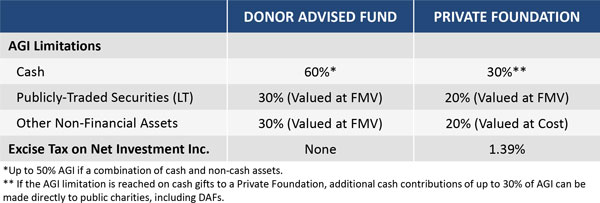
Private Foundations and DAFs are subject to different tax treatment. In Part 1, we compared the income tax deductions. Gifts to private foundations are subject to lower Adjusted Growth Income (AGI) limitations than gifts to a DAF. In addition, private foundations are subject to an annual excise tax of 1.39% on net investment income.

Conclusion
Donor Advised Funds and Private Foundations are commonly used charitable vehicles that may effectively help you reach your philanthropic goals. They offer very different levels of control, flexibility and legacy building. The choice between philanthropic vehicles also does not need to be an either/or decision. Donor Advised Funds can be a great complement to a Private Foundation. When used together, they can be an optimal solution for managing wealth and achieving philanthropic impact.

How do you decide what makes sense for your family? Here are some questions to discuss with your Oxford Advisors to help guide the decision:

  1. What is your giving style?
  2. Do you require more flexibility or control over investments or grantmaking?
  3. How much do you wish to donate?
  4. What level of family involvement do you desire?
  5. Do you want the vehicle to extend through multiple generations?

The information contained in this report is confidential and proprietary to Oxford and is provided solely for use by Oxford clients and prospective clients. The opinions expressed are those of Oxford Financial Group, Ltd. The opinions are as of date of publication and are subject to change due to changes in the market or economic conditions and may not necessarily come to pass. The information in this presentation is for educational and illustrative purposes only and does not constitute investment, tax or legal advice. Tax and legal counsel should be engaged before taking any action. OFG-2401-38

Charitable Giving Vehicles: Part 1 – Donor Advised Funds

By: Susan Hagley, MST
Senior Wealth Strategist

There are many charitable giving vehicles available to help you carry out your philanthropic goals. Two of the more commonly used options to consider are a Donor Advised Fund or a Private Foundation. Both will allow you the opportunity to be more strategic with your charitable giving and to create a philanthropic legacy for your future generations.

In this first email in our two-part series, we will discuss Donor Advised Funds. Understanding the distinct advantages and drawbacks is the key to deciding which vehicle is best suited for your circumstances and goals.

Basics
A Donor Advised Fund (DAF) is a giving account that is housed in a public charity (the sponsoring organization). Donor Advised Funds are a simple and efficient way to make a charitable impact. Donors may contribute assets and receive a current year income tax deduction. The funds can then be invested and grow tax-free while the donor has flexibility to recommend grants to charity over time. This provides families with time to develop a thoughtful giving plan.

Setting up a DAF involves selecting a sponsoring organization (such as a national nonprofit or a community foundation) and completing their requisite form or application. There is generally no cost involved in opening a DAF and it can typically be established and ready in a few days. Once the DAF account is open, the donor makes an irrevocable gift that cannot be returned or used for any purpose other than grantmaking to charities.

Administration
Once established, the sponsoring organization handles the administrative work at a low cost. This includes managing investments, record keeping, tax receipts and grant administration. The donor retains advisory privileges to make grant requests and, in some cases, select an investment advisor. Sponsoring organizations typically have suggested minimum payouts and limits on the length of time without any grants being made. They may also require a grant if the overall fund did not meet its total required payout.

Grantmaking
Donor Advised Funds are required to give to 501(c)(3) public charities. Therefore, they are not able to make grants to private foundations or individuals, such as for scholarships or hardships. They also may not make grants to fulfill multiyear pledges. The DAF sponsoring organization handles the due diligence related to grantmaking. The donor may request grants to specific public charities. Then, the sponsoring organization is responsible for reviewing the grant requests and must approve them before they are made.

Privacy
DAFs provide donors with the ability to make anonymous grants, providing privacy if that is desired. This can be accomplished because DAFs do not have an annual filing requirement, so names of individual donors are not disclosed to the public. In addition, a gift can be presented to the charity disclosing only the name of the sponsoring organization.

Contributions and Asset Selection
When making any gift, asset selection is an important consideration. Ideal assets to gift to a DAF are long-term appreciated securities, especially those with low basis. This is the most tax-efficient method because securities that have been held for more than one year can be donated at their fair market value and it eliminates the capital gains tax on the sale. It also maximizes the charitable dollars available because the DAF is not subject to tax.

The most common assets to gift to a DAF include cash, publicly-traded securities and mutual funds. However, some donors desire to gift complex non-cash assets, such as non-publicly-traded stock or an LLC interest. Key considerations when donating complex assets include whether the supporting organization will accept the asset, if it can be transferred and liquidated, how long the process will take, how soon liquidity is needed and how much an appraisal will cost to determine the fair market value.

Family Engagement
To engage the next generation, donors may wish to create a Legacy Plan for their DAF. Typically, donors act as the primary advisors and appoint their children or loved ones as secondary advisors. Depending on the sponsoring organization, other succession options may include dividing the DAF for individual successors, naming charities as beneficiaries to receive the remaining assets or endowing a DAF to continue making grants to designated charities for a period of time. The Legacy Plan may also include a Family Philanthropic Mission Statement. This allows donors and families to communicate charitable intent and provide guidelines for grantmaking.

Income Tax Deductions for Taxpayers who Itemize Deductions 
Charitable giving is not only a generous and compassionate act, but it also can be an effective tax strategy. Donors who itemize their deductions on their income tax return may qualify for a charitable contribution deduction. The tax deduction is limited to a percentage of your AGI and contributions that exceed these limitations can be carried over in each of the next five years until used. 

DAFs and private foundations are subject to different tax treatment, summarized below. In years you donate a significant portion of income to charity or have a highly appreciated asset to contribute, you may receive a larger tax benefit through the use of a DAF.

Conclusion
Part 2 of this series will discuss private foundations to further help you understand which charitable vehicle may make sense for your family.

The information contained in this report is confidential and proprietary to Oxford and is provided solely for use by Oxford clients and prospective clients. The opinions expressed are those of Oxford Financial Group, Ltd. The opinions are as of date of publication and are subject to change due to changes in the market or economic conditions and may not necessarily come to pass. The information in this presentation is for educational and illustrative purposes only and does not constitute investment, tax or legal advice. Tax and legal counsel should be engaged before taking any action. OFG-2401-35

Death and (Estate) Taxes – Advance ILIT Planning for Life’s “Certainties”

by: Tyler Rosser, JD.
Wealth Strategist

Death and Taxes…as vexing to confront as they are certain to occur. In this area, we should heed the advice of Winston Churchill, who suggested that we “let our advance worrying become advance thinking and planning.”

Advance thinking and planning in the fields of life insurance and estate tax planning, although important for everyone, are even more essential and nuanced for those facing a taxable estate. The looming 40% estate tax presents a myriad of planning opportunities to transfer wealth outside of the taxable estate.

This e.Insight explores how using an Irrevocable Life Insurance Trust (ILIT) can provide significant relief from estate tax liability and allow a greater percentage of a decedent’s wealth to pass to the intended beneficiaries.

Irrevocable Life Insurance Trust (ILIT) Overview

An ILIT is an irrevocable trust that is primarily designed to serve as the owner and beneficiary of one or more life insurance policies insuring the life of the grantor. The primary advantage of utilizing an ILIT is the removal of the death benefit from the grantor’s gross estate. A life insurance death benefit only has a 60% effective realization rate when subject to estate tax, and if exemption amounts are reduced by one-half in December 2025 as anticipated, a greater percentage of estates will shift towards the taxable category1. If more estates become subject to estate tax, the ILIT will likely become an even more prevalent strategy for tax-efficient life insurance planning.

In addition to estate tax savings benefits, ILITs provide asset protection advantages by shielding assets from the creditors of the ILIT beneficiaries and the creditors of the grantor. By paying the death benefit into the trust as opposed to outright to the beneficiaries, an ILIT allows a grantor to stipulate how and when the life insurance death benefit is distributed to beneficiaries. This allows the grantor to secure asset protection for children, grandchildren and future generations.

An ILIT may also be designed so that the proceeds from any life insurance policy are made available as a source of liquidity to pay any estate tax owed. Funding estate tax liability upon death is a common concern for closely held business owners who have a significant portion of their wealth concentrated in illiquid, closely held business interests. Utilizing an ILIT strategy can prevent the estate of a deceased business owner from being forced to liquidate closely held business interests to pay estate tax.

To escape estate tax under an ILIT strategy, the grantor cannot have an “incident of ownership” (as defined in I.R.C. § 2042) over the life insurance policy such that the proceeds of the policy are subject to a power of disposition by the grantor2. In essence, the grantor must relinquish control over the life insurance policy for it to be excluded from the gross estate.

ILIT Premium Funding

A primary consideration and potential challenge to the implementation of a successful ILIT strategy is determining how to fund the annual premium payments. Because the primary (and oftentimes sole) asset of an ILIT is a life insurance policy, many ILITs lack adequate liquid assets to make the annual premium payment. The grantor cannot simply make the annual premium payments on behalf of the ILIT, because to do so would trigger gift tax consequences. The federal gift tax, which also has a rate of 40%, works in tandem with the federal estate tax to prevent the shifting of wealth during life in an attempt to avoid estate tax at death.

Based on factors such as the size of the annual premium payment, the grantor’s liquidity position, the grantor’s remaining gift and estate tax exemption and the specific terms of the ILIT, one or more of the following strategies may be ideal to fund premium payments.

I. Annual Exclusion Gifting (Crummey Withdrawal Rights)

A widely-used strategy to fund premium payments involves the grantor transferring cash to the ILIT and using the annual exclusion to avoid making a taxable gift. In 2023, the annual exclusion amount is $17,000 per recipient. If the grantor’s spouse is not a trust beneficiary, the grantor’s spouse may also gift this amount per recipient to the ILIT. The amount of the premium payment and the number of ILIT beneficiaries will determine whether annual exclusion gifting will satisfy the premium funding requirement.

For example, consider an ILIT that has eight current beneficiaries (grantor’s spouse is not a beneficiary) and annual premium payments owed totaling $250,000. The total amount of annual exclusion gifting available to these recipients by grantor and grantor’s spouse equals $272,000 ($17,000 x 2 x 8). Because the total amount of annual exclusion gifting available to the ILIT exceeds the premium payment owed, the grantor (with the participation of grantor’s spouse) can satisfy the premium payment through annual exclusion gifting to the ILIT and thereby avoid making a taxable gift.

For a gift to qualify for the annual exclusion, the gift must be a present interest gift3. On its face, a grantor’s contribution of cash to an ILIT for the purpose of paying the premium is not a present interest gift to the beneficiary recipients; rather, it is a future interest gift against which no annual exclusion is allowed. However, through the use of Crummey Withdrawal Rights, the gift to the ILIT can be transformed into a present interest gift that qualifies for the annual exclusion.

Crummey Withdrawal Rights (also called Crummey Powers) give the beneficiary a limited time to withdraw contributions made to a trust in order to make the contribution to the trust a present interest gift4. When a contribution is made to the trust, the trustee will send out a Crummey Notice to each beneficiary stating the right to withdrawal the beneficiary’s proportional amount of the contribution. The right to withdrawal should remain open for a period of at least 30 days to give the beneficiary a meaningful time to exercise. Upon expiration of the withdrawal period, the right to withdrawal lapses. While a grantor or trustee may not prohibit a beneficiary from exercising a withdrawal right, the presumption with this strategy is that beneficiaries will not exercise the right to withdrawal and the grantor’s contribution to the trust will be used to fund the premium payment.

II. Lifetime Exemption Utilization

If a grantor’s available annual exclusion gifting amount is inadequate to cover the entire premium, a portion of the grantor’s lifetime exemption can be applied to fund the difference. If the above example is modified such that the annual premium payments total $400,000 (increased from $250,000) and the beneficiary and annual exclusion assumptions remain constant ($272,000 of annual exclusion availability), the grantor could annually use $128,000 of lifetime exemption to cover the difference. Depending upon the size of the grantor’s estate, the grantor’s remaining exemption and additional estate planning strategies that have or will be implemented, this may or may not be an optimal strategy to fund the premium.

III. Premium Financing

It is common for the annual premium of a substantial life insurance policy to exceed the grantor’s annual exclusion, remaining estate tax exemption or available liquidity. Additionally, a grantor may not wish to utilize cash to fund ILIT insurance premiums if doing so would have a high opportunity cost (i.e., if the cash required for the premium could be invested elsewhere earning a higher rate of return). When these considerations are present, premium financing may be an attractive option.

  • Private (Family) Loan
    A private (intra-family) loan is a technique to allow the grantor to fund premium payments without triggering significant gift tax consequences. This strategy is particularly useful when the annual exclusion is inadequate to cover the premium payments and the grantor is willing to use liquid assets to fund the premium. The strategy involves the grantor (or a family trust or entity) transferring liquid assets to the ILIT to fund the premium and receiving an interest-only promissory note from the ILIT in return. The annual interest payments can be funded through annual exclusion gifting or by accessing the cash value of the policy, and the principal balance can be satisfied from death benefit proceeds upon the grantor’s death.
  • Third-Party (Bank) Loan
    Using a third-party lender to lend directly to the ILIT allows the grantor to retain assets in higher returning investments and thereby limits the grantor’s out-of-pocket commitment to finance premiums. The ILIT will need a source of funds for loan payments and likely collateral. Gifting may cover loan payments or payments may be made from the cash value of the policy. If loan payments are made from cash value, the overall economic value of the insurance policy will decrease. Collateral may come from the insurance policy itself or from a personal guarantee. However, a personal guarantee without the ILIT paying a corresponding surety or guarantee fee may subject the grantor to gift tax exposure.

The loan ultimately must to be repaid. Oftentimes, the loan will be repaid from the built-up cash value of the life insurance policy, the death benefit proceeds, monetization of a separate illiquid asset held by the trust (such as closely-held business interests or real estate) or a subsequent lifetime exemption gift by the grantor. Another common approach is to systematically transfer liquid assets to the ILIT over time through related wealth transfer strategies such as grantor-retained annuity trusts (GRATs) that avoid gift and estate tax inclusion. The remainder interest from a series of GRATs can be used to provide the ILIT with liquidity to pay all or part of the principal balance of the third-party loan.

Conclusion

While death and taxes might be life’s certainties, advance planning allows for optimization of outcomes. The difference in outcomes between an estate that has engaged in advance planning and one that has not can be so significant that classifying estate taxes as a “certainty” begins to feel like a misnomer. ILITs can be an excellent strategy for the mitigation and funding of federal estate tax, the protection and preservation of assets and the enhanced transfer of wealth to future generations; these strategies are most effective when carefully considered and planned in advance. Your Oxford team is well positioned to ensure that your plan is optimized for life’s “certainties” and that you have developed an optimal estate and wealth transfer strategy.

1The gift and estate tax exemption and the GST exemption are $12,920,000 in 2023. The exemptions are slated to return to $5,000,000 (indexed for inflation) as of December 31, 2025, unless modified or extended by Congress.
2See I.R.C. § 2042.
326 C.F.R § 25.2503-3 defines “present interest” as an “unrestricted right to the immediate use, possession, or enjoyment of property or the income from property.”
4See Crummey v. Commissioner, 397 F.2d. 82 (9th Cir. 1968).

The information in this presentation is for educational and illustrative purposes only and does not constitute tax, legal or investment advice. Tax and legal counsel should be engaged before taking any action. OFG-2303-25

The Future of Planning for the Well-Planned

“Good fortune is what happens when opportunity meets with planning.” – Thomas Edison

Congratulations…To the well-guided, well-informed and well-planned families who have utilized their full lifetime estate tax exemptions, known more formally as their Gift, Estate and Generation-Skipping Transfer (GST) tax exemptions.

You have skewed the bell curve for many affluent families seeking to protect their generational wealth. You understand that the alpha of outperforming the market, owning other appreciating assets or having a successful business can pale in comparison to the 40% haircut your wealth will suffer when it passes to your heirs.

As you certainly know, however, assets remaining in your taxable estate will continue to appreciate, as will your liability to the IRS. While there will likely be several more years of inflation increases in tax exemptions, your future wealth and tax planning must evolve and become more strategic and diligent than ever.

This article summarizes several broad techniques that are highly impactful for the well-planned family, to provide inspiration and vision that you can still fight the good fight to protect your generational wealth, even with little or no remaining lifetime tax exemptions.

Estate Freezing Techniques

Estate freezing strategies are designed to guard your future appreciation from the estate and GST tax. These strategies can involve one or more of a variety of gifts, sales, annuities and lending transactions.

I. Gifts and Sales to Capitalized Spousal Lifetime Access Trusts (SLATs) and other Family Trusts

Many families utilized their full lifetime exemptions to gift assets to a SLAT or other variations of an Irrevocable Grantor Trust. Families still have this same opportunity prior to the anticipated sunset of current laws in December, 2025, upon which the exemptions are slated to be essentially cut in half.1

These families now have an ideal opportunity to sell additional appreciating assets to their funded trusts, in return for non-appreciating promissory notes that can carry the low Applicable Federal Rate (AFR). When properly structured, capital gains are not recognized in this type of sale.

For further information on this and other benefits of a capitalized family trust, see “Doing Business with Your Family SLATs”, Oxford e.Insights, April 6 2022, Doing Business With Your Family SLATs.

II. Squeezing the Value of the Remaining Taxable Estate with Valuation Discounts

Utilization of these gift and/or sale techniques can be further enhanced by taking full advantage of valuation discounts to maximize the number of shares or units of the entity being transferred to the trust, while minimizing the corresponding “purchase price” owed back to the Grantor. The most common types of valuation discounts used in these strategies are discounts for lack of marketability and lack of control. Not only does appreciation of the entity continue outside of the Grantor’s taxable estate, but there is also an immediate net benefit to the trust, which now owns an asset worth more than its corresponding liability.

III. The Tax Burn

These types of trusts provide another significant benefit. While most gifts utilize either lifetime exemption or annual gift tax exclusion, these trusts enable the grantor to pay taxes on behalf of the trust, thereby preserving the value of trust assets. These tax-free gifts to future generations are known as the tax burn.

IV. Zeroed-out Gifts: The Grantor Retained Annuity Trust (GRAT) and Charitable Lead Annuity Trust (CLAT)

Both GRATs and CLATs are designed to redirect future appreciation from the grantor’s taxable estate to a remainder beneficiary, typically a children’s or descendant’s trust. With a GRAT, the lead annuity beneficiary is the grantor for the term of the GRAT.2 With a CLAT, it is a qualified charity.3

With both, however, the remainder interest is considered a taxable gift, potentially subject to gift tax. This ‘gift’, however, can be reduced to zero by predetermining the lead beneficiary’s annuity payments so that the present value equals (and thereby ‘zeroes-out’) the value of the remainder gift.

Strategies to Ensure Full Use of Each Exemption

I. I Love You, May I Have Your Exemption?

Let’s talk about your options if you have utilized all of your gift and estate exemption, but your spouse has not and has significant assets in his/her taxable estate. In that scenario, there is opportunity to minimize your family’s potential estate tax liability by taking advantage of strategies for your spouse to use his/her remaining exemption. There are a number of approaches that could be implemented to achieve this goal, but a very common strategy for families in this situation is for the spouse who has not exhausted his/her exemption (“Spouse 1”) to create a SLAT for the other spouse’s (“Spouse 2”) benefit and fully fund it to the extent of his/her remaining exemption. This would remove the assets from Spouse 1’s estate (potentially at a discounted rate), while still allowing Spouse 2 to access the income or principal of the trust if needed. Remember, the gift and estate exemption, GST exemption and annual exclusion limits are applied per person, so it is important to always be sure to exhaust all of these exemptions and exclusions to the extent possible for both spouses.

II. Making Taxable Gifts to Use Remaining GST Tax Exemption – The Math Works

Some family members may find they have remaining GST exemption, but no remaining gift exemption to pair with it. They might consider paying gift tax to fund a dynastic trust in order to fully utilize GST exemption, particularly before the December, 2025 sunset.

The math works…Gift tax is a one-time 40% tax, whereas GST exemption will provide estate tax savings for multiple generations, more than making up for the gift tax cost. Further, gift tax is ‘estate exclusive,’ because these tax dollars are removed from the taxable estate. If GST is applied at death, the tax is inclusive in the estate, resulting in a tax on the tax. Lastly, there is no portability for GST tax exemption, making it more precarious whether both spouse’s exemption will ever be fully utilized.

Our Next Steps and Yours

Throughout 2023, we will present a series of articles on strategies for the ‘well-planned’ family, covering additional topics such as Domestic Asset Protection Trusts (DAPTs) to safeguard wealth, optimizing the annual gift tax exclusion, strategies to save state income tax and crafting an efficient plan to pay any remaining estate tax.

In the meantime, your Oxford team of advisors wish you and yours a very happy and healthy holiday season, and stand ready to consult with you on these topics and all of your wealth planning considerations.


​1The Gift and Generation-Skipping Transfer (GST) tax exemptions were $12,060,000 in 2022 and are set to increase to $12,920,000 in 2023.
2The Grantor must survive the term of the GRAT or all assets will come back into the Grantor’s taxable estate.
3With a CLAT, the Grantor is eligible for an upfront charitable deduction for the present value of the charity’s annuity interest.

A Peaceful Holiday Season for Taxpayers, but What Lies Ahead?

At the turn of the 17th Century, William Shakespeare wrote his play, Much Ado About Nothing. Much the same could be said so far about the numerous tax legislative proposals introduced in Congress during 2021. The initial proposals introduced in early 2021 contained a wide-ranging list of potential income and estate tax reforms, many previously not contemplated and some introduced with retroactive effective dates. Throughout the year, the various proposals were negotiated and the focus narrowed, ultimately resulting in the House passage of its version of the Build Back Better Act on November 19, 2021.

The Build Back Better Act has been the subject of intense negotiations aimed toward gaining the support of at least fifty Senators, a necessity to get the legislation passed in the Senate via reconciliation. Senator Joe Manchin, however, announced last week that he has pushed away from the negotiating table and will not support the Build Back Better Act as currently drafted. Senator Manchin’s vote was seen as critically necessary for the legislation to pass through the Senate. This decision effectively ended the prospect of tax reform in 2021.

Of great significance is the resulting inability to impose any retroactive tax reform for the 2021 tax year. Retroactive effective dates were an element of many reform proposals and a great source of uncertainty throughout this past year. However, this does not mean that all wealth enhancement planning should stop for affluent families. It remains a possibility that an even more narrowly focused tax bill could be passed in 2022.

In essence, a “tax manuscript” has been published for all to see. Families and advisors should consider several key issues that will remain a source of planning concern going forward.

I. Estate, Gift and GST Tax Exemption Sunset

  • The current Estate, Gift and Generation-Skipping Tax Exemptions remain, but are still set to ‘sunset’ on December 31, 2025, thereupon reducing the exemptions essentially in half. Note, the exemptions for 2022 have been announced at $12,060,000 per person.
  • While there was no early reduction in these amounts included in the proposed Build Back Better Act, affluent families should still consider utilizing the elevated exemptions where appropriate and while they remain available under our current laws.

II. Valuation Discounts

  • Earlier versions of tax reform included the elimination of valuation discounts. This topic has frequently been a prime target for reform, both legislatively and through changes in regulations. In fact regulatory changes were proposed by the Treasury Department as recent as five years ago, but later were scuttled.
  • For those families that would benefit from the appropriate use of currently available valuation discounts as part of their wealth enhancement planning, there may be no better time to act.

III. Taxation of Certain Trusts

  • The Build Back Better Act included a wholly new proposal for an income surtax of 5% on Non-Grantor Trusts with income greater than $200,000 and an additional 3% if the trust’s taxable income exceeded $500,000.
  • With the introduction of this new risk to certain trusts, it would be prudent for individuals and advisors to reconsider trust income taxation issues, including distribution standards and capital gain income provisions in new and existing trusts.
  • Further, to enhance flexibility, families may consider utilizing a Trust Protector with an ability to modify the trust terms to account for future tax changes.

If we had a nickel for every time we heard the quote, “don’t let the tax tail wag the dog”, we would have collected many nickels over 2021. Upon our reflection, however, the dog finally wagged its tail for many affluent families who treated the prospect of tax reform as an impetus to update legacy and wealth transfer plans in a very positive way. That momentum should continue in 2022 as families consider what could have been and what might still be.

Your Oxford team is positioned to ensure that our affluent family clients continue to develop thoughtful wealth enhancement strategies and implement them timely and efficiently. Consultation with your Oxford team and an analysis of the possible impact of any tax policy changes will allow your full team of advisors to identify the optimal solutions for your family.


The information in this presentation is for educational and illustrative purposes only and does not constitute tax, legal or investment advice. Tax and legal counsel should be engaged before taking any action. OFG-2112-16