

For nearly a decade, the Qualified Opportunity Zone (QOZ) program lived under a statutory deadline. Enacted under the Tax Cuts and Jobs Act of 2017, it required investors to recognize all deferred capital gains no later than December 31, 2026. That deadline is why late 2026 has become such an active planning season for family offices holding legacy Qualified Opportunity Fund (QOF) positions.
At its simplest, a Qualified Opportunity Zone (QOZ) is a designated low-income census tract that Congress wants to see more private investment reach. A Qualified Opportunity Fund (QOF) is the vehicle that gets capital there. It pools eligible capital gains from investors, and in exchange for deploying that money into qualifying property or businesses inside a QOZ, it offers deferral and eventual reduction of the tax on those gains.
The One, Big, Beautiful Bill Act of 2025 (OBBBA) changed the underlying premise. Section 70421 made the Opportunity Zone program permanent, and IRS Notice 2026-40, transitional guidance from the Treasury Department and the IRS, supplies the rules connecting the expiring legacy regime (“OZ 1.0”) to the new permanent framework (“OZ 2.0”). Together they turn what was once a temporary incentive into a recurring feature of the tax code, complete with its own mechanics, its own deadlines and, since this is still a ten-year illiquid commitment, its own opportunity cost.
We will walk through what changed in the transition and what stayed the same, then turn to the question most relevant to Qualified Opportunity Zones: Does the tax benefit outweigh the investment risk, illiquidity, fees and opportunity cost that come with it?
Notice 2026-40 and the Permanent OZ 2.0 Regime
Congress originally designed Opportunity Zones under IRC §1400Z-2 as a temporary economic development tool, offering deferral of capital gains through 2026, a partial basis step-up for early investors and elimination of tax on post-acquisition appreciation after a 10-year hold. Section 70421 of the OBBBA converted that temporary structure into a permanent one. Under OZ 2.0, state governors will nominate low-income census tracts for recurring 10-year designation cycles, with the first cycle running from January 1, 2027 through December 31, 2036.1
Notice 2026-40, a piece of transitional guidance issued by Treasury and the IRS rather than a statute in its own right, resolves several open questions in bridging the two regimes. Chief among them is the statutory cap limiting designated zones to 25% of a state’s low-income communities “during any period” under §1400Z-1(d)(1). Because legacy OZ 1.0 tracts remain designated through December 31, 2028, some advisors worried the overlap would shrink the number of new tracts available for OZ 2.0. The Notice clarifies that the 25% cap applies independently to each 10-year designation period, so existing OZ 1.0 tracts do not reduce the inventory available for new OZ 2.0 nominations.2
Rev. Proc. 2026-14 sets the nomination calendar. State chief executives were able to submit and revise OZ 2.0 nominations from July 1, 2026 through September 28, 2026, with a single 30-day extension available on request. Treasury and the IRS identified 25,332 eligible census tracts nationwide, of which 8,334 are composed entirely of a rural area and qualify as Rural Opportunity Zones.3
The distinction matters for planning. Capital invested through a Qualified Rural Opportunity Fund (QROF) in one of these tracts could receive as much as a 30% basis step-up at the five-year mark, three times the 10% standard step-up available elsewhere under OZ 2.0, reflecting Congress’s intent to direct more of the permanent incentive toward non-metropolitan communities.4
An OZ 1.0 tract does not automatically carry forward into the new regime, a detail that catches many clients by surprise. Each tract must independently satisfy OZ 2.0’s tightened eligibility test and receive its own nomination and designation, and new capital deployed into a tract that is not renominated will not qualify for OZ 2.0 treatment.5
A key point to note is that many states and localities apply their own conformity rules, and some run separate opportunity zone-style programs of their own, so confirming state treatment before relying on any after-tax projection is a reasonable starting point.
OZ 2.0 Versus OZ 1.0: What Actually Changes
The permanent regime changes more than the sunset date. The mechanics are easiest to follow once you separate the two tax incentives at work here, deferral on the original capital gain and elimination of tax on the fund’s own appreciation, since conflating them is the most common source of confusion.6
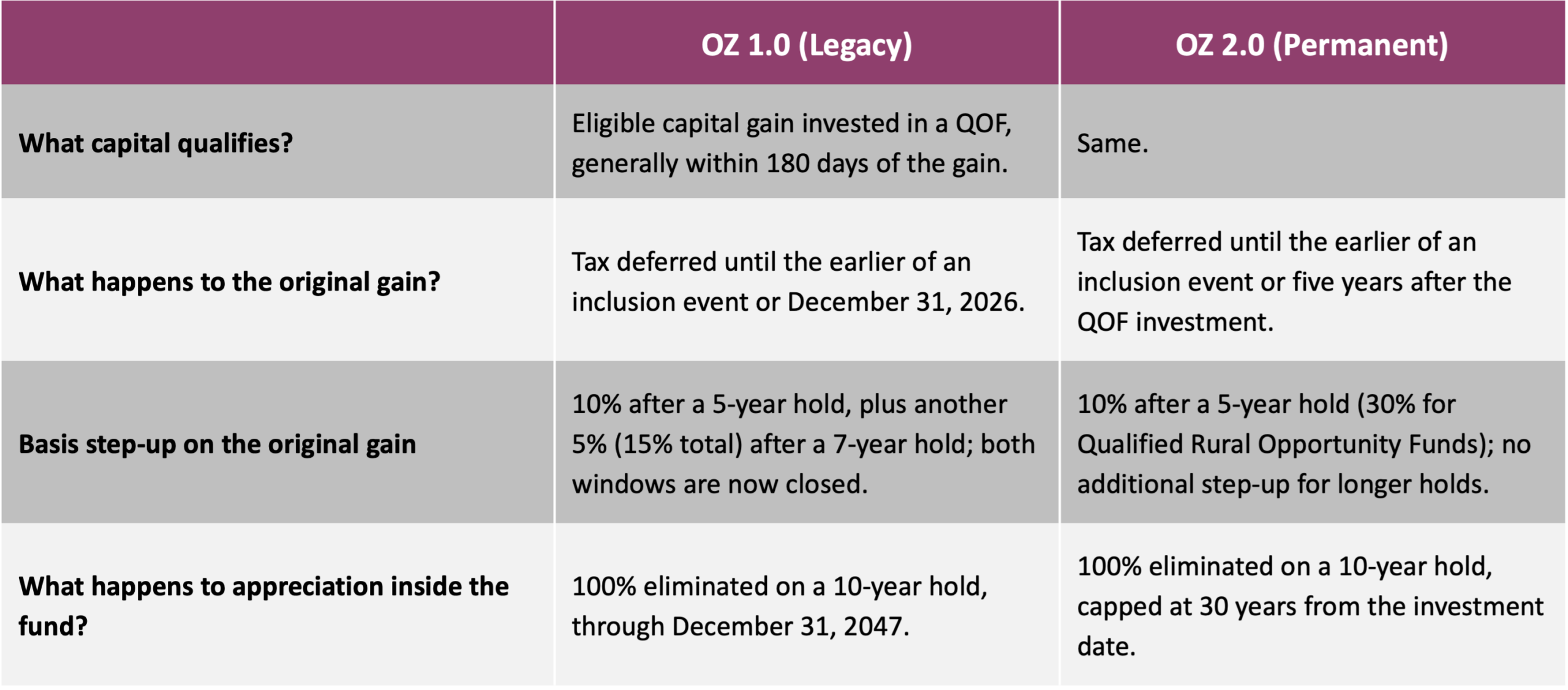
The Deemed Inclusion Event
Two mechanics deserve a closer look because they affect every legacy investor regardless of new deployment plans. Under Section 4.01 of Notice 2026-40, every legacy QOF investment still held as of December 31, 2026 must recognize its remaining deferred gain on the 2026 return, payable in spring 2027. That gain cannot be re-deferred into a new fund; the original deferral election remains in effect, so the recognized amount is not treated as new eligible gain. The taxable amount is the original deferred gain, reduced by any basis step-up already earned under the 5- or 7-year holding rules above. It is further capped at the investment’s fair market value on December 31, 2026 if that value is lower, which is why a rigorous, independent valuation matters in any sector where values have softened. Paying this tax does not end the benefit. An investor who keeps the QOF interest for a full 10 years may still qualify for the step-up to fair market value on disposition under §1400Z-2(c), through December 31, 2047 for legacy assets.7
The Safe Harbor for Legacy Developers
Tangible property acquired after December 31, 2026 in an OZ 1.0 tract will generally fail to qualify as Qualified Opportunity Zone Business Property unless it fits one of two exceptions under Section 5.01: a written working capital plan (up to 31 months) adopted by December 31, 2026, with at least 10% of capital received and 5% expended or committed by that date, or an ordinary-course replacement of existing assets, such as routine renovations, that does not expand the project’s footprint or scope.8
For new capital, the practical difference comes down to timing. Gain deployed into a QOF on or before December 31, 2026 falls under OZ 1.0 and offers no step-up, and deferral only through December 31, 2026; the same gain, deployed on or after January 1, 2027, starts a fresh five-year deferral clock and a 10% (or 30% for Qualified Rural Opportunity Funds) basis step-up under OZ 2.0.
Evaluating the Opportunity Cost of Capital Lock-up
Tax incentives are only half of the underwriting question. Sound family office governance calls for weighing that benefit against what the capital would otherwise earn, and against how long it will be committed.
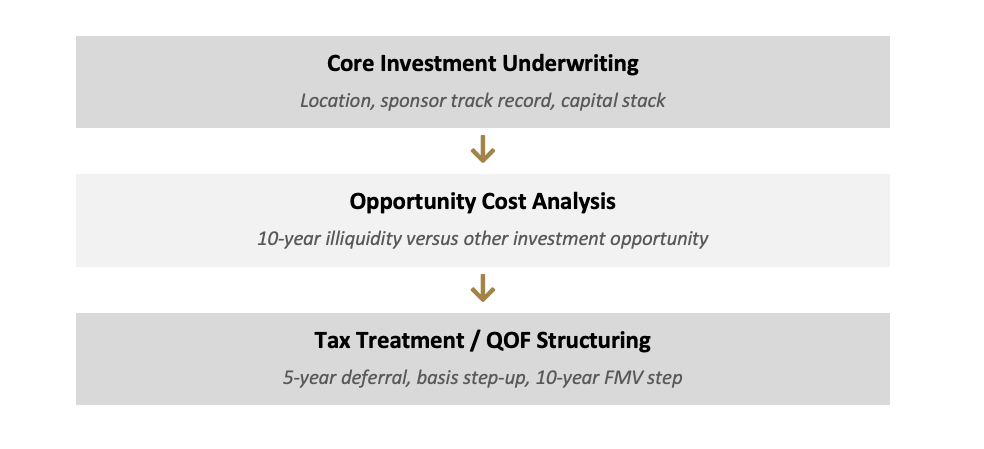
The 10-Year Illiquidity Premium
Whether under OZ 1.0 or OZ 2.0, the core benefit, elimination of tax on appreciation under §1400Z-2(c), requires a minimum 10-year hold, and up to 30 years under the new statutory cap. In a zero-rate environment, locking up capital for a decade was a low-cost trade. In a higher-for-longer environment where core fixed income, private markets and public equities may offer competitive after-tax returns on their own, that same lock-up now carries a genuine cost, in the form of reduced ability to rebalance through a market dislocation and, for ground-up projects, added exposure to development, supply chain and refinancing risk over a long horizon.
The Phantom Tax Cash Drag
Legacy investors face a distinct liquidity event in spring 2027. The tax bill on the 2026 deemed inclusion gain comes due in outside cash, while the underlying asset may still be years from stabilization. Sponsors that once expected to fund these liabilities through cash-out refinancings now face a tighter debt market, which shifts more of that burden onto the family office’s own balance sheet.
Sponsor and Fee Scrutiny
A QOF deserves the same underwriting rigor as any private equity commitment. Acquisition fees, professional fees and other costs can erode the after-tax benefit the code is designed to provide. The underlying investment can still lose money like any illiquid real asset, and tax benefits can be forfeited through noncompliance, independent of investment performance, if a QOF or QOZB fails to meet asset-testing or certification requirements.
What the Data Actually Shows
An August 2026 Government Accountability Office (GAO) review put total Opportunity Fund assets at roughly $108 billion at the end of 2024, concentrated in urban multifamily housing, mixed-use development and hotels. GAO found, echoing a similar finding in its 2020 review, that no centralized data exists on which projects are funded, and that investment has skewed toward tracts that already had infrastructure and community support in place, rather than the most economically distressed communities the program was designed to reach. The earliest QOF investments were made in 2018 and 2019, however, so the first cohort of full 10-year holds is only now maturing. Even a complete data set today would say relatively little about realized, full-cycle outcomes, since most of the program’s history to date has been the accumulation phase rather than the exit phase.9
OZ 2.0 takes a meaningful step toward closing this gap. The permanent regime requires QOFs to report fund and investor characteristics annually, with Treasury due to publish outcome data by the program’s sixth year. As that reporting accumulates, investors and their advisors should be better positioned to judge whether realized returns justify the illiquidity, fees and opportunity cost described throughout this piece, rather than relying on the tax mechanics alone. None of this diminishes the tax benefits available today, but it does argue for underwriting the underlying investment on its own merits.10
Estate and Trust Considerations
An Opportunity Zone position raises estate and trust questions best surfaced well before a liquidity event forces the issue. What happens to a QOF interest at death, including how it is valued and whether the fund’s own operating agreement restricts transfer, deserves the same attention as any other illiquid asset in an estate plan. Lifetime gifting of a QOF interest raises its own question about whether the transfer itself triggers an inclusion event. And for a trust considering a QOF allocation, the illiquidity described above deserves a hard look against the trust’s distribution obligations to beneficiaries. These are highly fact-specific questions, best worked through with counsel alongside the family’s broader estate plan.
Conclusion
Notice 2026-40 accomplishes what it set out to do: it gives legacy investors, developers and fund sponsors a workable bridge from a temporary incentive to a permanent one, with transitional guidance for the 2026 transition and a durable framework beyond it. That clarity is valuable, but it answers a different question than whether a given Opportunity Zone investment is the right long-term financial play for a portfolio.
The permanence of OZ 2.0 means this decision will keep coming up, for existing legacy positions working through the 2026 transition and for new capital weighing deployment into the years ahead. Families and their advisors are likely best served by treating the tax benefit as one input among several, alongside the underlying investment’s own merits, its illiquidity, its estate and trust implications and the still-thin record of how prior-generation Opportunity Zone investments have actually performed. How much weight each family gives those factors is, appropriately, a complex equation that needs to be an ongoing consideration.
One related structure we get asked about often is the two-layer strategy of operating a Qualified Opportunity Zone Business directly within a QOF. It carries its own operating, financing and exit considerations beyond the scope of this piece, and we plan to address it, along with the risks specific to it, in a follow-up article.
Clients with questions about how this topic may relate to their own circumstances are encouraged to speak with their Oxford advisory team and their tax and legal advisors.
Oxford Financial Group, Ltd. (“Oxford”) is a Registered Investment Advisor (“RIA”) with the U.S. Securities and Exchange Commission (“SEC”) and is headquartered in Carmel, Indiana. Registration with the SEC does not imply a certain level of skill or training. Additional information about Oxford, including our Form ADV and Privacy Policy, is available upon request by calling 800.722.2289 or emailing info@ofgltd.com. The content of this presentation is intended for educational and illustrative purposes only. It should not be construed as investment, tax or legal advice, nor as a recommendation or offer to buy or sell any security or investment product. The strategies referenced above are illustrative in nature and may not be available, suitable or advisable for every individual, entity or transaction. No strategy discussed guarantees the achievement of any tax, estate planning or transaction objective. Investing involves risk, including possible loss of principal. Investing involves risk, including possible loss of principal. Tax and legal counsel should be engaged before taking any action. This material has been prepared using original sources believed to be reliable, but no representation is made as to its accuracy or completeness. The views expressed are those of Oxford as of the date of the presentation and are subject to change based on market, regulatory or economic conditions, which may not occur as anticipated. For full disclosures and disclaimers, please visit https://ofgltd.com/home/disclaimers. OFG-2610-05
1 One, Big, Beautiful Bill Act, Pub. L. No. 119-21, § 70421 (2025), amending IRC § 1400Z-1(f)(1).
2 IRC § 1400Z-1(d)(1); IRS Notice 2026-40, § 3.01(1) (June 18, 2026).
3 Rev. Proc. 2026-14 (IRS, Apr. 6, 2026).
4 IRC § 1400Z-2(b)(2)(B)–(C), as amended by One, Big, Beautiful Bill Act, Pub. L. No. 119-21, § 70421 (2025).
5 Rev. Proc. 2026-14 (IRS, Apr. 6, 2026).
6 IRC §§ 1400Z-2(a)–(c), as amended by One, Big, Beautiful Bill Act, Pub. L. No. 119-21, § 70421 (2025); IRS Notice 2026-40, §§ 4.01, 5.01–5.02 (June 18, 2026).
7 IRS Notice 2026-40, § 4.01 (June 18, 2026); IRC § 1400Z-2(a), (c).
8 IRS Notice 2026-40, § 5.01(2)–(3) (June 18, 2026).
9 U.S. Government Accountability Office, GAO-26-108132, Opportunity Zones: Effects of Original Tax Incentive Mostly Unknown and Revised Incentive May Offer Improvements (Aug. 24, 2026).
10 REG-116506-25, 91 Fed. Reg. 57968 (proposed Sept. 11, 2026).